
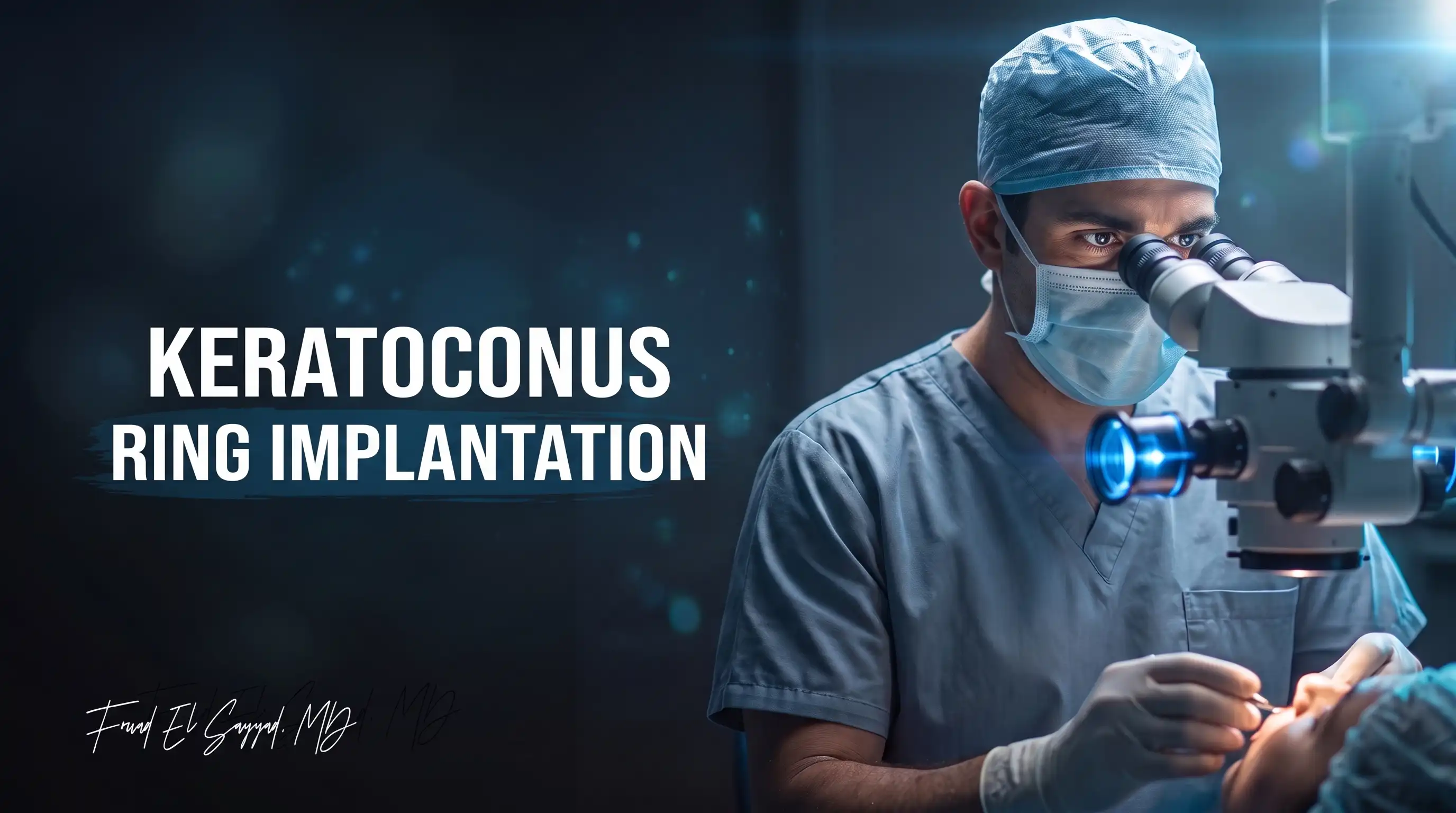
Corneal ring implantation for keratoconus

Home Corneal ring implantation for keratoconus

Keratoconus ring implantation is one of the important surgical options included in keratoconus treatment plans. It may help improve the shape of the cornea and the quality of vision in certain cases, especially when glasses or contact lenses do not provide sufficient results.

Keratoconus is a corneal disease that causes the cornea to become thinner and gradually bulge outward. This leads to blurred vision, increased astigmatism, and difficulty achieving clear vision over time. It is one of the most common conditions related to corneal problems and diseases.

Dr. Fouad El-Sayyad, Consultant of Corneal Surgeries and Vision Correction, provides a detailed assessment of keratoconus cases to determine the most suitable treatment plan for each patient, whether through corneal ring implantation, corneal cross-linking, or combining more than one procedure depending on the condition of the cornea and the degree of disease progression.

In this article, we will discuss the most important information about keratoconus ring implantation, including the idea behind the procedure, suitable candidates, required tests before surgery, the steps of the procedure using femto laser technology, expected results, and the most important post-operative instructions.

Keratoconus Ring Implantation

Keratoconus ring implantation is a surgical procedure in which tiny ring segments are inserted inside the thickness of the cornea to modify its shape and reduce corneal steepness and irregularity. This may help improve vision quality or make the use of glasses or contact lenses easier after the procedure.

These rings are usually made of a biocompatible material and are placed inside precise tunnels within the cornea. They help flatten part of the cone-shaped cornea and reduce the irregular astigmatism caused by the disease.

It is important to clarify that ring implantation does not restore the cornea completely to its natural shape, nor is it a treatment that directly stops the progression of keratoconus. However, it helps improve the regularity of the corneal surface in suitable cases. Corneal cross-linking, on the other hand, is the procedure that aims to strengthen the cornea and reduce the risk of further deterioration.

This procedure may help delay or reduce the need for corneal transplantation in some suitable cases. However, it does not replace corneal transplantation in advanced cases associated with severe central corneal opacity or scarring.

In many cases, femto laser technology is preferred for creating tunnels inside the cornea, as it helps determine the depth and position of the rings with high precision compared to manual methods. This contributes to a higher level of safety and accuracy during the procedure.

Who Are the Suitable Candidates for Keratoconus Ring Implantation?

Keratoconus ring implantation is suitable for some patients with keratoconus, especially in mild to moderate stages, or in selected more advanced cases, provided that the cornea has sufficient thickness and there is no significant central opacity.

Cases that may be suitable for the procedure include:

  • Patients with keratoconus who have corneal steepness or irregular astigmatism that affects vision quality.

  • Cases that do not achieve sufficient vision with prescription glasses.

  • Patients who cannot tolerate rigid contact lenses or have difficulty using them.

  • Cases with no severe central corneal scarring or opacity.

  • Patients whose corneal measurements allow ring implantation to be performed safely.

The suitable age is determined according to the patient’s condition, the degree of disease progression, and corneal thickness. Some younger patients may need early treatment, especially if the disease is worsening. Therefore, the decision does not depend on age alone, but rather on test results and the activity level of keratoconus.

Dr. Fouad El-Sayyad evaluates each case individually to determine whether corneal ring implantation is the most suitable option, or whether the patient needs corneal cross-linking or another treatment.

Required Tests and Preparations Before Ring Implantation Surgery

Before undergoing keratoconus ring implantation, the patient needs a set of detailed tests to assess the shape, thickness, and steepness of the cornea. The success of the procedure depends greatly on selecting the right case and accurately planning the position of the rings.

The most important tests before the procedure include:

  • A comprehensive eye examination to measure visual acuity, examine the cornea, measure eye pressure, and ensure there are no other problems that may affect the outcome of the procedure.

  • Corneal topography to determine the shape of the cornea, the degree of steepness, and the level of irregularity.

  • Corneal tomography to obtain a more detailed assessment of the corneal layers and thickness.

  • Measuring corneal thickness in different areas, as thickness is a key factor in determining whether rings can be implanted safely.

  • Evaluating the patient’s ability to use glasses or contact lenses and understanding how much the disease affects daily life.

The doctor may ask the patient to stop wearing contact lenses for a specific period before the tests so the cornea can return as close as possible to its natural shape and the measurements become more accurate.

The patient should also inform the doctor about any medications being taken, chronic diseases, or previous eye surgeries so that a suitable and safe treatment plan can be created.

Steps of Keratoconus Ring Implantation Using Femto Laser Technology

Keratoconus ring implantation is usually performed under local anesthesia using anesthetic eye drops. It does not take a long time in most cases, although the duration of the procedure may vary depending on each patient’s condition and treatment plan.

The procedure is usually performed through the following steps:

  • Eye anesthesia: Anesthetic drops are applied to reduce discomfort during the procedure.

  • Eye stabilization: The doctor uses a special instrument to help keep the eye stable during surgery.

  • Creating tunnels inside the cornea: Femto laser technology helps create precise tunnels inside the cornea according to pre-determined measurements.

  • Inserting the rings: The rings are placed accurately inside their designated tunnels according to the corneal shape and degree of steepness.

  • Checking the ring position: The doctor ensures that the rings are stable and placed in the correct position.

  • Applying medical eye drops: Antibiotic and anti-inflammatory drops are applied after the procedure according to the doctor’s instructions.

Dr. Fouad El-Sayyad determines the details of the procedure for each patient based on the test results, as the size, position, and depth of the rings vary from one case to another.

Main Advantages of Keratoconus Ring Implantation Compared to Other Treatments

Keratoconus ring implantation is one of the options that may help improve vision in many suitable cases, especially when the main problem is caused by irregular corneal shape.

The main advantages of ring implantation include:

  • It helps reduce corneal steepness and improve the regularity of the corneal surface.

  • It may contribute to improving vision quality and reducing irregular astigmatism.

  • It does not require removing part of the corneal tissue.

  • It is considered safe in suitable cases when planned accurately.

  • In some cases, the rings can be removed or replaced if necessary.

  • It may delay or reduce the need for corneal transplantation in some cases.

  • It may make the use of glasses or contact lenses easier after the procedure.

However, it is important to understand that results vary from one patient to another. The goal of the procedure is not always to completely eliminate the need for glasses or contact lenses, but rather to improve the shape of the cornea and vision quality as much as possible.

When Does Vision Improve After Keratoconus Ring Implantation?

Vision improves gradually after keratoconus ring implantation. In the first few days, the patient may notice some blurriness or unclear vision, which may occur due to temporary changes in the cornea after the procedure.

Improvement usually begins to appear during the first few weeks, then vision continues to stabilize gradually over several months. Some patients may need to adjust their glasses prescription or use contact lenses after the procedure to achieve the best possible vision.

This may differ from the answer to the question: when does vision improve after corneal cross-linking? This is because the nature and goal of each procedure are different from one case to another.

It is important for the patient to understand that ring implantation does not necessarily mean complete independence from glasses or contact lenses. However, it may help improve vision or make vision correction easier compared to before the procedure.

Dr. Fouad El-Sayyad follows up with the patient after surgery through regular visits to ensure ring stability, corneal safety, and the level of vision improvement.

Important Tips and Instructions After Ring Implantation to Support Its Success

Following the doctor’s instructions after keratoconus ring implantation is one of the most important factors that help reduce complications and improve the chances of achieving a good result.

The most important post-operative instructions include:

  • Use the prescribed eye drops regularly, whether antibiotic drops, anti-inflammatory drops, or lubricating drops.

  • Avoid rubbing the eye completely, as eye rubbing may affect the position of the rings or cause corneal irritation.

  • Avoid pressing on the eye or touching it unnecessarily.

  • Protect the eye from dust, wind, and sunlight by using protective glasses or sunglasses when needed.

  • Avoid getting water or soap into the eye during the first few days according to the doctor’s instructions.

  • Avoid swimming, violent sports, and activities that may expose the eye to injury for the period determined by the doctor.

  • Returning to some office-based activities is usually possible within a few days, depending on the eye condition and the doctor’s opinion.

  • Attend follow-up visits to ensure that the rings remain stable and healing is progressing safely.

The patient should not stop using the drops or change their schedule without consulting the doctor, even if vision improves early.

Success Rate of Keratoconus Ring Implantation and Possible Complications

Keratoconus ring implantation provides good results in many suitable cases, especially when the patient is carefully selected, the procedure is planned based on corneal measurements, and an appropriate technique such as femto laser is used.

However, like any surgical procedure, some complications may occur, even if they are uncommon. These may include:

  • Inflammation or infection after the procedure, which can be reduced by following the prescribed drops and instructions.

  • Movement of the rings from their position in some cases.

  • Not achieving the expected level of vision improvement.

  • Halos or glare around lights, especially in low-light conditions.

  • Irritation or a foreign body sensation inside the eye during the recovery period.

  • Ring extrusion or the ring becoming close to the corneal surface, which may occur with corneal thinning or eye rubbing and may require ring adjustment or removal.

  • Formation of opacities or scars around the ring site in rare cases.

For this reason, Dr. Fouad El-Sayyad discusses the expected results and possible risks with the patient before surgery so that expectations are realistic and clear.

Can Keratoconus Ring Implantation Be Combined With Corneal Cross-Linking?

Yes, keratoconus ring implantation may be combined with corneal cross-linking in some cases, especially when the goal is to improve the shape of the cornea while reducing the risk of further deterioration.

Each procedure has a different function. Ring implantation aims to improve corneal regularity and reduce steepness, while corneal cross-linking aims to strengthen the cornea and reduce the likelihood of keratoconus progression.

Ring implantation and cross-linking may be performed in the same session or in separate stages. The suitable timing is determined according to the condition of the cornea, the activity level of the disease, corneal thickness, and test results.

Dr. Fouad El-Sayyad determines the appropriate plan for each case after a detailed assessment, as some patients may need corneal cross-linking first, while combining both procedures may be suitable in other cases.

What Happens If Ring Implantation Does Not Succeed?

In some cases, keratoconus ring implantation may not achieve the desired level of improvement, or a problem may appear that requires intervention. In this situation, the doctor determines the appropriate plan according to the cause of the problem and the condition of the cornea.

Available options may include:

  • Monitoring the condition for a period until the cornea becomes more stable.

  • Adjusting glasses or contact lenses after vision stabilizes.

  • Adjusting the position of the ring in some cases.

  • Removing or replacing the rings if they cause a problem or do not achieve the desired result.

  • Resorting to corneal transplantation in advanced cases that are not suitable for rings or where severe scarring affects vision.

Dr. Fouad El-Sayyad ensures regular follow-up after the procedure to evaluate the result and intervene early if any problem appears.

Cost of Keratoconus Ring Implantation in Egypt

The cost of keratoconus corneal ring implantation in Egypt ranges from EGP 20,000 to EGP 25,000 per eye, while the cost for both eyes starts from EGP 40,000, in addition to the ring cost, which may range from EGP 3,200 to EGP 5,000. The cost may vary from one case to another, and an accurate price cannot be determined before examining the cornea and evaluating the suitable treatment plan.

The cost of the procedure is affected by several factors, including:

  • The type of rings used.
  • The use of femtosecond laser technology.
  • The examinations required before the procedure.
  • The condition of the cornea and degree of curvature.
  • Whether the patient will need corneal cross-linking along with ring implantation or not.
  • The level of the medical center and the equipment used.
  • The number of follow-up visits required after the procedure.

Some patients may need to compare the cost of corneal rings with the cost of corneal cross-linking, which starts from EGP 15,000 per eye, while both eyes start from EGP 28,000, especially in cases where the doctor suggests combining both procedures or choosing the most suitable procedure according to the progression of the condition.

To get an accurate cost with Dr. Fouad El-Sayyad, it is recommended to contact the clinic after examination and determine the required type of treatment, as the treatment plan differs from one patient to another depending on the corneal condition and the severity of keratoconus.

Important note: All mentioned prices are estimated starting prices and may vary according to each patient’s condition. The final cost is only determined after consultation and medical examination.

Why Do Some Patients Choose Dr. Fouad El-Sayyad for Keratoconus Treatment?

Choosing the right doctor for keratoconus cases requires precise experience in evaluating the cornea and determining the most suitable treatment, as every case differs in terms of corneal steepness, corneal thickness, the extent of vision impairment, and the possibility of disease progression.

Some patients choose Dr. Fouad El-Sayyad for keratoconus treatment for several reasons, including:

  • His specialized experience in corneal surgeries and vision correction.

  • Relying on detailed tests to evaluate the condition of the cornea before making a treatment decision.

  • Using modern technologies such as femto laser in suitable cases.

  • Creating an individualized treatment plan according to each patient’s condition, whether through ring implantation, corneal cross-linking, or a combination of more than one procedure.

  • Regular follow-up after the procedure to evaluate ring stability, corneal safety, and vision improvement.

  • Explaining treatment options clearly to the patient before making a decision.

This approach helps provide more accurate and realistic medical care, while avoiding absolute promises and setting suitable expectations for each case.

Conclusion

Keratoconus ring implantation is one of the surgical solutions that may help improve the shape of the cornea and vision quality in some keratoconus cases, especially when the case is carefully selected and the procedure is accurately planned.

However, it is important to know that rings do not necessarily stop the progression of the disease, nor do they restore the cornea completely to its natural shape. They help improve the regularity of the corneal surface and reduce steepness. Corneal cross-linking, on the other hand, is the procedure that aims to reduce the risk of continued keratoconus deterioration.

If you suffer from keratoconus or would like to know the most suitable treatment for your condition, you can contact Dr. Fouad El-Sayyad’s center to receive a detailed assessment and an appropriate treatment plan.

For booking and inquiries via WhatsApp: …..

Frequently Asked Questions

What is the cost of corneal ring implantation in Egypt?

The cost of corneal ring implantation in Egypt varies depending on the condition of the cornea, the type of rings used, the use of femto laser, and the required tests before the procedure. Therefore, an accurate cost cannot be determined before examining the cornea and defining the suitable treatment plan.

Does vision improve after ring implantation?

Yes, vision may improve after ring implantation in many suitable cases, as the rings help reduce corneal steepness and improve the regularity of the corneal surface. However, some patients may still need glasses or contact lenses after the procedure to achieve the best possible vision.

What is ring implantation for keratoconus?

It is a surgical procedure in which tiny rings are implanted inside the thickness of the cornea to modify its shape and reduce the irregularity caused by keratoconus. This may help improve vision quality in suitable cases.

What is the success rate of keratoconus ring implantation?

Ring implantation provides good results in many suitable cases, but the outcome varies depending on the degree of keratoconus, corneal thickness, the presence of opacity or scarring, and the patient’s commitment to post-operative instructions.

Does ring implantation permanently treat keratoconus?

No, ring implantation does not permanently treat keratoconus and does not necessarily stop the disease. It helps improve the shape of the cornea and the quality of vision. If the disease is progressing, the patient may need corneal cross-linking.

Will I need glasses after ring implantation?

Some patients may need glasses or contact lenses after ring implantation to achieve the best possible vision. The goal of the procedure is to improve corneal regularity and vision, not necessarily to completely eliminate the need for vision correction methods.

Are rings better than corneal cross-linking?

There is no direct comparison between them, because each procedure has a different function. Rings aim to improve the shape of the cornea and reduce steepness, while corneal cross-linking aims to strengthen the cornea and reduce the risk of further deterioration.

Can corneal rings be removed after implantation?

Yes, in some cases, the rings can be removed or replaced if necessary, such as when the desired improvement is not achieved or if a problem occurs with the position of the ring. This is done according to the doctor’s assessment.

Is ring implantation suitable for all keratoconus patients?

No, ring implantation is not suitable for all cases. The decision depends on corneal thickness, degree of steepness, presence of opacity or scarring, extent of vision impairment, and the patient’s ability to use glasses or contact lenses.

circle

Book an Eye Consultation Appointment | Dr. Fouad El Sayyad

Book now

contact-circle-2