
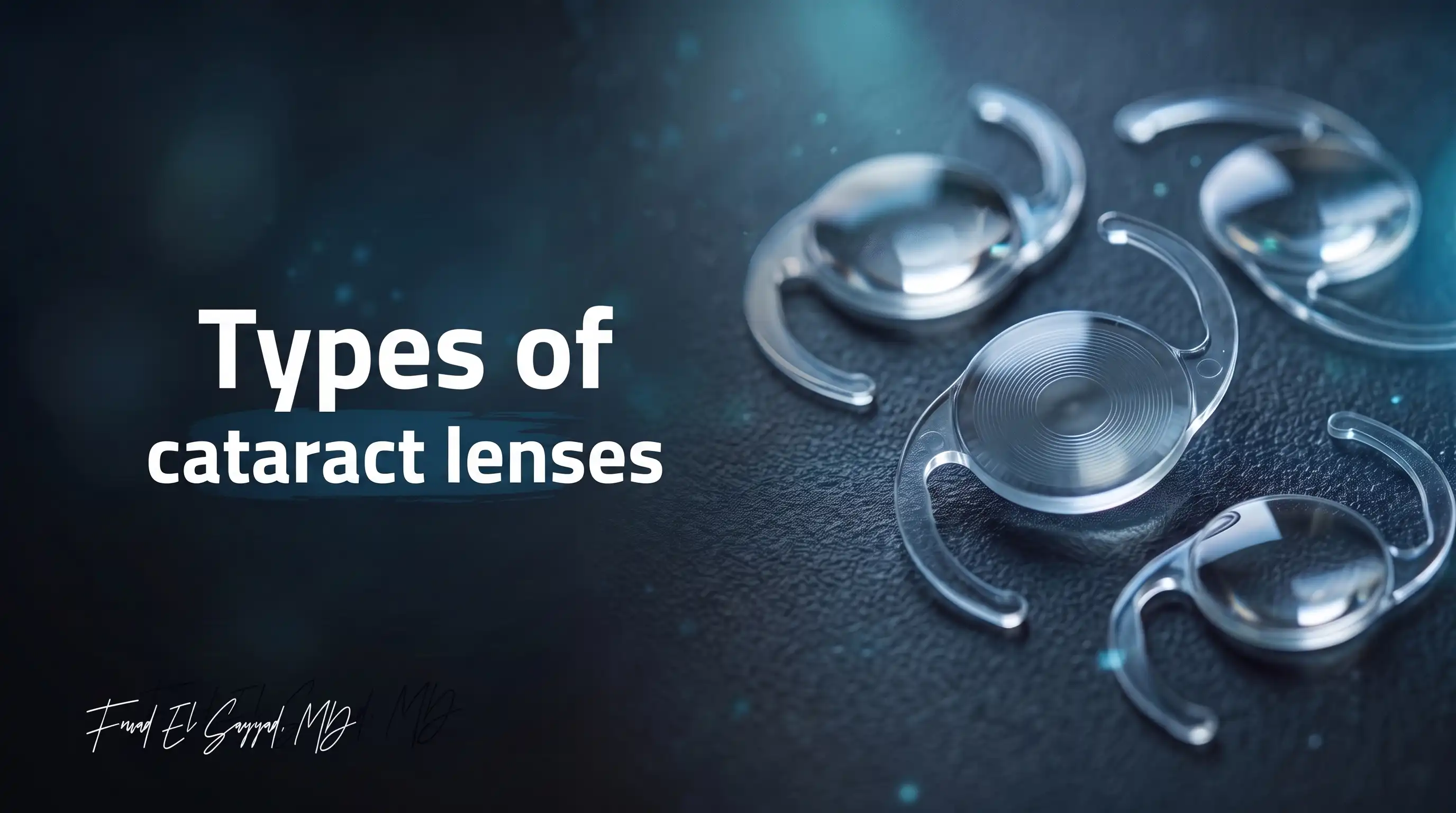
Quick answer: Cataract lens implants (IOLs) come in several main types: monofocal, enhanced monofocal, extended depth of focus (EDOF), trifocal, and mix-and-match or complementary combinations, most of which are also available in toric versions for astigmatism. I choose the lens with each patient based on careful measurements, eye health and daily needs. No lens is best for everyone, and a more expensive lens is not automatically better.
Key Takeaways
- Every lens type has strengths and trade-offs; the right one depends on your eyes and how you live.
- Monofocal lenses give excellent distance vision, but reading glasses are usually needed.
- EDOF and trifocal lenses reduce the need for glasses but can cause halos at night, especially at first.
- Toric lenses correct regular astigmatism and can be combined with most designs.
- Eye conditions such as macular disease, glaucoma, dry eye or previous LASIK can limit the choice.
Why Is a Lens Implanted After Cataract Surgery?
Your natural lens does much of the eye’s focusing. When I remove the cloudy lens during cataract surgery, I replace it with a clear artificial lens (intraocular lens, or IOL) placed inside the natural lens capsule. It stays there permanently. The type of lens decides how you see at different distances afterwards. Read the complete guide to cataract surgery and lens implantation.
What Types of Cataract Lens Implants Are There?
| Lens type | Vision without glasses | Trade-offs | Examples of lenses I use |
|---|---|---|---|
| Monofocal | Sharp at one distance, usually far | Reading glasses needed; fewest night halos | Alcon Clareon, J&J Tecnis, J&J Sensar, Bausch + Lomb enVista |
| Enhanced monofocal | Distance plus a little intermediate | Reading glasses usually still needed | J&J Tecnis Eyhance, BVI Isopure |
| EDOF (extended depth of focus) | Distance and intermediate (computer, dashboard) | Fine print may need glasses; slightly fewer night halos than trifocal | Alcon Vivity, J&J Tecnis PureSee, SIFI Mini WELL (progressive EDOF) |
| Trifocal | Distance, intermediate and near | More likely halos and glare at night; needs healthy eyes | Alcon PanOptix, BVI FineVision |
| Mix-and-match (EDOF + multifocal) | An EDOF lens in one eye and a trifocal or multifocal lens in the other, for a wide range with both eyes together | Both eyes must be treated; needs careful planning | Combinations of the EDOF and trifocal lenses above |
| Complementary system | Two lenses designed as a pair, one in each eye | Both eyes must be treated | Cristalens Artis Symbiose (Mid and Plus) |
| Toric | Adds astigmatism correction to the chosen design | Must be aligned precisely | Toric versions of most of the above |
These are the main lenses I use, all from established American and European manufacturers, and other options are available when an eye needs them. Lens availability can change over time.
Monofocal Lenses: Who Are They Best For?
A monofocal lens focuses light at one distance, usually far. It gives very clear, high-quality vision with the fewest night halos, and it suits almost every eye, including eyes with macular disease, glaucoma or corneal problems. Most patients need reading glasses afterwards. Some patients choose monovision: one eye set for distance and the other slightly for near, to reduce the need for reading glasses.
What Is an Enhanced Monofocal Lens?
Enhanced monofocal lenses are designed to give good distance vision with a little more intermediate range than a standard monofocal, for example for a car dashboard or a computer screen at arm’s length. They are not multifocal lenses, so reading glasses are usually still needed for small print, but night halos are similar to a standard monofocal.
What Is an EDOF Lens?
Extended depth of focus (EDOF) lenses stretch the range of clear vision from distance to intermediate. They suit active people who drive, use computers and want fewer glasses, usually with slightly fewer night halos than a trifocal. Very fine print may still need reading glasses. Progressive EDOF designs such as the SIFI Mini WELL use a gradual change in power across the lens to extend the range.
What Is a Trifocal Lens?
Trifocal lenses split light into three focal points: distance, intermediate and near. They offer the most freedom from glasses, but some light is spread between the focal points, so halos and glare around lights at night are more common, and contrast can be slightly lower. The brain usually adapts over a few weeks to months. I recommend trifocal lenses only for healthy eyes, after a careful discussion of expectations.
EDOF or Trifocal: What Does the Evidence Show?
A 2024 Cochrane review found that distance vision is similar with trifocal and EDOF lenses, while trifocal lenses give better near vision and less need for reading glasses. A 2023 meta-analysis in the American Journal of Ophthalmology found the same advantage for near vision, with similar distance and intermediate vision and only small differences in halos and glare. In my experience, EDOF lenses cause slightly fewer halos, while trifocal lenses give better reading vision. In practice, the choice comes down to how much you read without glasses and how healthy your eyes are.
What Is Mix-and-Match Lens Implantation?
Mix-and-match means using a different lens in each eye so that the two eyes work together. Usually, an EDOF lens is placed in one eye, often the dominant eye, for clear distance and intermediate vision with a smooth range, and a trifocal or multifocal lens in the other eye to add near vision. The brain combines both, giving a wide range of vision while balancing the strengths of each design. A 2026 meta-analysis of five studies found good early binocular vision at distance, intermediate and near with this approach, although the evidence is still limited. I consider mix-and-match for selected patients who want a wide range of vision and have healthy eyes, and it needs both eyes to be operated.
What Is a Complementary Lens System?
Complementary systems take the same idea further: two lenses designed by the manufacturer to work as a pair, one in each eye. The Cristalens Artis Symbiose system pairs a Mid lens, which favours intermediate vision, with a Plus lens, which favours near vision, so that both eyes together give a wider range than either lens alone. This approach works best when both eyes have cataract surgery.
Do I Need a Toric Lens for Astigmatism?
If you have significant regular astigmatism from the cornea, a toric lens can correct it at the same time as the cataract, so distance vision is sharper without glasses. Most lens types come in toric versions. The lens is rotated to a precise axis during surgery, based on corneal tomography and IOLMaster 700 measurements. Irregular astigmatism, for example from keratoconus, needs an individual plan.
How Do I Choose the Right Lens for You?
I choose the lens with you, not for you. The decision depends on:
- Your daily life: driving at night, reading, computer work, sports and hobbies
- Your goals: how much you mind wearing reading glasses, and how you feel about possible night halos
- Your eye health: a careful slit-lamp examination of the cornea, corneal endothelium and ocular surface, plus the retina, optic nerve and eye pressure
- Your measurements: IOLMaster 700 biometry, corneal tomography and, when needed, OCT of the retina
- Your history: previous LASIK, PRK or SMILE, which changes the lens calculation and can affect premium lens results
A healthy ocular surface matters even more with toric, EDOF and trifocal lenses. Dry eye or eyelid inflammation is treated before the final measurements.
“I never pick a lens from a brochure. I pick it from your measurements, your eye health and the way you spend your day, and sometimes the simplest lens gives the happiest patient.” — Dr. Fouad El Sayyad
Who Should Avoid Trifocal or EDOF Lenses?
- Macular disease, advanced glaucoma or other retinal or optic nerve disease
- Significant corneal irregularity or uncontrolled dry eye
- Patients who drive a lot at night professionally and cannot accept halos
- Patients with very high expectations of perfect vision at every distance
For these eyes, a monofocal or enhanced monofocal lens often gives the best quality of vision.
Can I Be Completely Free of Glasses?
Many patients with EDOF or trifocal lenses do most daily tasks without glasses, but no lens can guarantee complete freedom from glasses at every distance and in every light. With a monofocal lens, most people need reading glasses. If glasses are needed, I usually prescribe them after about a month. Read when vision stabilises after cataract surgery.
Do Lens Implants Last for Life?
Yes. A lens implant is designed to last for life and does not wear out or need replacing. Months or years after surgery, the capsule behind the lens can become cloudy (posterior capsule opacification). This is not the cataract returning and is treated with a quick YAG laser. Exchanging a lens implant is possible but rarely needed.
How Much Do Cataract Lenses Cost?
The price depends mainly on the lens type, and lenses are imported and priced mainly in euros and US dollars. See the cataract surgery cost guide.
What Patients Say (Google Reviews)
I had two cataract operations with lens implants. Honestly, and I have to say it, Dr. Fouad El Sayyad is a person of great character in every sense of the word, and all the nurses and reception staff are extremely respectful.
Google review · Sayyad Eye Center, Mohandeseen · July 2026 · translated from Arabic
Where Does Dr. Fouad El Sayyad See Patients?
- Sayyad Eye Center, Mohandeseen (main branch, where cataract surgery is performed): 3A Gameat El Dowal El Arabeya St., Sphinx Square.
- Sayyad Eye Center, New Cairo: Medical Park 2, opposite New Cairo Court.
To book an appointment with Dr. Fouad El Sayyad, call or WhatsApp 01000088168.
Frequently Asked Questions
Are American and European lenses better than Indian or Asian lenses?
What matters is the lens design, material, regulatory approval and long-term track record, not the country alone. I use lenses with strong clinical evidence and proven long-term results, and I explain the options and their differences before surgery.
How much do cataract lenses cost?
The cost depends mainly on the lens type: monofocal lenses cost least, and EDOF, trifocal and toric lenses cost more. Your exact price is confirmed after the examination. See the cataract surgery cost guide.
Which cataract lens is best?
There is no single best lens. The right lens depends on your eye health, measurements and daily needs. For some patients a monofocal lens is best; for others an EDOF or trifocal lens suits their lifestyle better.
Which lens is most comfortable for the eye?
All modern lens implants are made of materials the eye tolerates very well, and you will not feel the lens. Comfort after surgery depends more on healing and the ocular surface than on the lens type.
Are multifocal lenses suitable for everyone?
No. Trifocal and EDOF lenses need healthy eyes and realistic expectations. Macular disease, advanced glaucoma, corneal irregularity or uncontrolled dry eye usually make a monofocal lens the better choice.
Do cataract lenses need to be replaced after some years?
No. A lens implant is designed to last for life. If vision becomes hazy later, it is usually clouding of the capsule behind the lens, which is treated with a quick YAG laser.
What is the difference between a toric lens and a regular lens?
A toric lens also corrects astigmatism. It has different power in different directions and is aligned to a precise axis during surgery, so distance vision is sharper without glasses.
Can cataract surgery make me completely free of glasses?
EDOF and trifocal lenses can reduce the need for glasses for most daily tasks, but no lens can guarantee complete freedom from glasses at every distance and in every light.
Will I see halos with a trifocal lens?
Many patients notice halos around lights at night at first. They usually become less noticeable over a few weeks to months as the brain adapts. EDOF lenses usually cause slightly fewer halos than trifocal lenses, and I discuss this openly before you choose.
What is a YAG laser after cataract surgery?
A YAG laser clears the capsule behind the lens implant when it becomes cloudy months or years after surgery. It takes a few minutes, is not painful and is usually needed only once.
This article is for general education and does not replace an eye examination. Treatment decisions depend on your own eye assessment.
References
- Tavassoli S, Ziaei H, Yadegarfar ME, et al. Trifocal versus extended depth of focus (EDOF) intraocular lenses after cataract extraction. Cochrane Database Syst Rev. 2024;7:CD014891.
- Karam M, Alkhowaiter N, Alkhabbaz A, et al. Extended depth of focus versus trifocal for intraocular lens implantation: an updated systematic review and meta-analysis. Am J Ophthalmol. 2023;251:52–70.
- Rakhimova M, Aldasheva N, Auyezova A, et al. Visual outcomes after mix-and-match implantation of trifocal and extended depth-of-focus intraocular lenses: a systematic review and meta-analysis. Medicina (Kaunas). 2026;62(6):1112.
- Miller KM, Oetting TA, Tweeten JP, et al. Cataract in the Adult Eye Preferred Practice Pattern. Ophthalmology. 2022;129(1):P1–P126.
This article is for general education and does not replace an eye examination. Treatment decisions depend on your own eye assessment.
FAQS
-
Are American and European lenses better than Indian or Asian lenses?
What matters is the lens design, material, regulatory approval and long-term track record, not the country alone. I use lenses with strong clinical evidence and proven long-term results, and I explain the options and their differences before surgery.
-
How much do cataract lenses cost?
The cost depends mainly on the lens type: monofocal lenses cost least, and EDOF, trifocal and toric lenses cost more. Your exact price is confirmed after the examination. See the cataract surgery cost guide.
-
Which cataract lens is best?
There is no single best lens. The right lens depends on your eye health, measurements and daily needs. For some patients a monofocal lens is best; for others an EDOF or trifocal lens suits their lifestyle better.
-
Which lens is most comfortable for the eye?
All modern lens implants are made of materials the eye tolerates very well, and you will not feel the lens. Comfort after surgery depends more on healing and the ocular surface than on the lens type.
-
Are multifocal lenses suitable for everyone?
No. Trifocal and EDOF lenses need healthy eyes and realistic expectations. Macular disease, advanced glaucoma, corneal irregularity or uncontrolled dry eye usually make a monofocal lens the better choice.
-
Do cataract lenses need to be replaced after some years?
No. A lens implant is designed to last for life. If vision becomes hazy later, it is usually clouding of the capsule behind the lens, which is treated with a quick YAG laser.
-
What is the difference between a toric lens and a regular lens?
A toric lens also corrects astigmatism. It has different power in different directions and is aligned to a precise axis during surgery, so distance vision is sharper without glasses.
-
Can cataract surgery make me completely free of glasses?
EDOF and trifocal lenses can reduce the need for glasses for most daily tasks, but no lens can guarantee complete freedom from glasses at every distance and in every light.
-
Will I see halos with a trifocal lens?
Many patients notice halos around lights at night at first. They usually become less noticeable over a few weeks to months as the brain adapts. EDOF lenses usually cause slightly fewer halos than trifocal lenses, and I discuss this openly before you choose.
-
What is a YAG laser after cataract surgery?
A YAG laser clears the capsule behind the lens implant when it becomes cloudy months or years after surgery. It takes a few minutes, is not painful and is usually needed only once.

Book an Eye Consultation Appointment | Dr. Fouad El Sayyad
Book now