
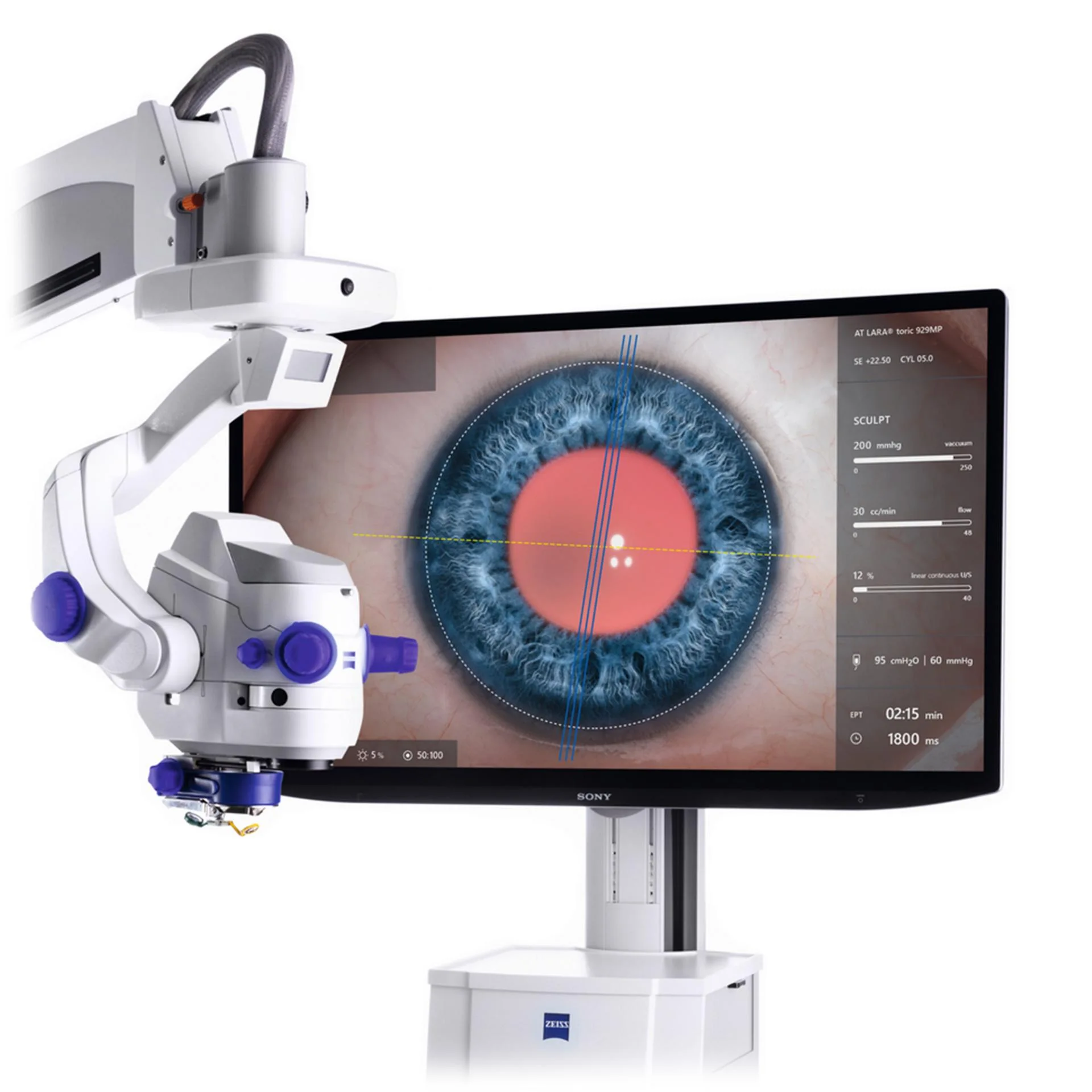
Quick answer: Cataract surgery improves vision in the large majority of patients. In large national registers, eyes without other eye disease reach an average vision close to normal, and patient-reported outcomes are consistently favourable. The final result depends mainly on the health of the rest of the eye, such as the retina, cornea and optic nerve, as well as the lens chosen and careful planning.
Key Takeaways
- Most patients see much more clearly after cataract surgery and report better daily function.
- Other eye conditions, such as macular degeneration, diabetic retinopathy or glaucoma, are the main reason the result can be limited.
- Accurate measurements and lens choice decide how much you will depend on glasses.
- A small residual prescription and later capsule clouding are common and easily treated.
- Laser-assisted surgery has not been shown to give better results than modern phaco.
What Does “Success” Mean After Cataract Surgery?
I look at success in three ways:
- Clear vision: sharper, brighter vision for your daily life
- The planned focus: how close the result is to the target we chose, for distance, reading or both
- A healthy, comfortable eye: no lasting complications and a calm ocular surface
A patient whose retina is healthy may reach near-perfect vision, while a patient with macular disease may gain less sharpness but still see brighter and more comfortably. Both can be a success when the expectation is set honestly beforehand.
What Do the Numbers Show?
The Swedish National Cataract Register, which covers more than 2.4 million operations, shows consistently favourable patient-reported outcomes and steadily falling complication rates over 30 years. In the same register, eyes without other eye disease reached an average corrected vision close to normal after surgery, and the average difference between the planned and achieved prescription was about 0.4 dioptres. Results in daily practice around the world vary widely, and a 2023 review in the British Journal of Ophthalmology found that the main reasons for poor results were uncorrected prescription, other eye diseases and complications such as capsule clouding.
What Affects the Result of Cataract Surgery?
| Factor | Why it matters |
|---|---|
| Health of the retina and optic nerve | Macular degeneration, diabetic retinopathy or glaucoma limit how sharp vision can become |
| Health of the cornea and ocular surface | A weak endothelium, corneal scars or dry eye affect clarity and measurements |
| Density of the cataract | Very dense cataracts make surgery harder and recovery slower |
| Accuracy of measurements | Determines how close you get to the planned prescription |
| Lens choice | Determines how much you need glasses for distance, intermediate and near |
| Previous LASIK, PRK or SMILE | Makes the lens calculation more demanding |
| Diabetes | In the Swedish register, eyes with diabetic retinopathy gained a similar amount of vision but ended slightly lower, with more surgical difficulty |
| Following the aftercare | Drops and follow-up protect the result |
How Do I Plan for the Best Result?
- A careful slit-lamp examination of the cornea, endothelium, ocular surface and lens support; dry eye is treated before measurements.
- Precise measurements with the ZEISS IOLMaster 700 and corneal imaging (CSO MS-39 in Mohandeseen, Pentacam in New Cairo), and OCT of the retina when needed.
- Choosing the lens together: monofocal, enhanced monofocal, EDOF, trifocal, toric or mix-and-match, according to your eyes and your lifestyle.
- Surgery on the Alcon Centurion under ZEISS microscopes, at the main branch in Mohandeseen.
- Clear aftercare and follow-up, starting with a day-1 check.
Does Laser Cataract Surgery Improve the Results?
No. Femtosecond laser-assisted surgery uses a laser for some early steps, but the cataract is still removed with phaco through an incision. The FEMCAT trial, published in The Lancet in 2020, found that it was not superior to standard phaco surgery, and it adds time to the operation. For this reason, I do not use it routinely. If a patient specifically asks for it, it can be arranged at another centre.
What If the Result Is Not What I Expected?
- A small residual prescription: corrected with glasses; in selected patients, a further correction may be discussed.
- Dry eye: fluctuating vision is often due to the ocular surface and improves with treatment.
- Capsule clouding (PCO): treated with a quick YAG laser.
- Macular oedema: found on OCT and treated with drops.
- Halos with EDOF or trifocal lenses: usually less noticeable over the first months as the brain adapts.
If a tear in the capsule happens during surgery, most patients still end up seeing better than before, although the result may take longer. Read about cataract surgery complications.
How Do I Choose a Cataract Surgeon?
- A surgeon who examines the whole eye, not only the cataract, and explains what result is realistic for you
- Accurate measurement technology and a range of lens options, with honest advice on which suits you
- Clear aftercare, easy access if a problem appears and regular follow-up
Read the complete guide to cataract surgery, how to choose a lens implant and when vision stabilises.
Where Does Dr. Fouad El Sayyad See Patients?
- Sayyad Eye Center, Mohandeseen (main branch, where cataract surgery is performed): 3A Gameat El Dowal El Arabeya St., Sphinx Square.
- Sayyad Eye Center, New Cairo: Medical Park 2, opposite New Cairo Court.
To book an appointment with Dr. Fouad El Sayyad, call or WhatsApp 01000088168.
Frequently Asked Questions
When is cataract surgery considered unsuccessful?
When vision does not improve as expected, usually because of another eye condition, a complication or an uncorrected prescription. Many of these can be treated, so a check with your surgeon is the first step.
Does vision return to normal after cataract surgery?
In eyes without other disease, vision often returns close to normal, sometimes with glasses for some tasks. Retinal, corneal or optic nerve disease can limit the final sharpness.
Can a cataract be removed without a lens implant?
Very rarely. Without a lens implant, the eye would need very thick glasses or contact lenses to focus. A lens implant is placed in almost every adult cataract operation.
Can cataracts cause dizziness?
Cataracts do not cause true dizziness, but poor vision, glare and a large difference between the eyes can affect balance and confidence, especially in older people. Surgery often helps.
Will I need glasses after cataract surgery?
That depends on your lens and your eye. With a monofocal lens, most patients need reading glasses. EDOF, trifocal and mix-and-match options reduce dependence on glasses, but none guarantees freedom from them.
Is cataract surgery more successful with a more expensive lens?
Not necessarily. A more expensive lens is not automatically better. The best lens is the one that suits your eye, your measurements and the way you use your vision.
Does diabetes affect the success of cataract surgery?
Diabetes can increase the risk of macular oedema and surgical difficulty, especially with diabetic retinopathy. Most patients with diabetes still gain useful vision, with careful planning and follow-up.
How long do the results of cataract surgery last?
The lens implant is permanent and the cataract does not come back. Vision can be affected later by capsule clouding, treated with a YAG laser, or by other age-related eye conditions.
This article is for general education and does not replace an eye examination. Treatment decisions depend on your own eye assessment.
References
- Miller KM, Oetting TA, Tweeten JP, et al. Cataract in the Adult Eye Preferred Practice Pattern. Ophthalmology. 2022;129(1):P1–P126.
- Bro T, Behndig A, Viberg A, et al. Two point four million cataract surgeries: 30 years with the Swedish National Cataract Register, 1992–2021. J Cataract Refract Surg. 2023;49(8):879–884.
- Ridderskär L, Montan P, Kugelberg M, et al. Outcome of cataract surgery in eyes with diabetic retinopathy: a Swedish National Cataract Register report. Acta Ophthalmol. 2022;100(2):e571–e577.
- Han X, Zhang J, Liu Z, et al. Real-world visual outcomes of cataract surgery based on population-based studies: a systematic review. Br J Ophthalmol. 2023;107(8):1056–1065.
- Segers MHM, Behndig A, van den Biggelaar FJHM, et al. Outcomes of cataract surgery complicated by posterior capsule rupture in the European Registry of Quality Outcomes for Cataract and Refractive Surgery. J Cataract Refract Surg. 2022;48(8):942–946.
- Schweitzer C, Brezin A, Cochener B, et al. Femtosecond laser-assisted versus phacoemulsification cataract surgery (FEMCAT): a multicentre randomised trial. Lancet. 2020;395(10219):212–224.
- Chen SP, Woreta F, Chang DF. Cataracts: a review. JAMA. 2025;333(23):2093–2103.
This article is for general education and does not replace an eye examination. Treatment decisions depend on your own eye assessment.
FAQS
-
When is cataract surgery considered unsuccessful?
When vision does not improve as expected, usually because of another eye condition, a complication or an uncorrected prescription. Many of these can be treated, so a check with your surgeon is the first step.
-
Does vision return to normal after cataract surgery?
In eyes without other disease, vision often returns close to normal, sometimes with glasses for some tasks. Retinal, corneal or optic nerve disease can limit the final sharpness.
-
Can a cataract be removed without a lens implant?
Very rarely. Without a lens implant, the eye would need very thick glasses or contact lenses to focus. A lens implant is placed in almost every adult cataract operation.
-
Can cataracts cause dizziness?
Cataracts do not cause true dizziness, but poor vision, glare and a large difference between the eyes can affect balance and confidence, especially in older people. Surgery often helps.

Book an Eye Consultation Appointment | Dr. Fouad El Sayyad
Book now