
The journey of treating keratoconus always begins with an accurate diagnosis, followed by choosing the right solution that helps you achieve clearer vision based on your condition. Scleral lenses for keratoconus are among the most commonly used options to improve vision for patients who do not achieve satisfactory results with eyeglasses. These lenses are specially designed to match the shape of the cornea and provide more stable and clearer vision.
In this article, you will learn what keratoconus lenses are, how they work, when you may need them, the different types of keratoconus treatment lenses available, how eye examinations and lens fitting are performed accurately, whether they can be used after corneal cross-linking surgery, in addition to explaining the price of scleral lenses for keratoconus in Egypt, the factors affecting their cost, important lens care tips, and why Dr. Fouad El Sayyad is the right choice for evaluating your condition and providing customized keratoconus lenses according to the latest medical standards. Continue reading until the end to learn more.
For a broader overview, see Treatment of keratoconus: key details.
What Are Keratoconus Lenses and How Do They Improve Vision?
When you develop keratoconus, the natural shape of the cornea gradually changes. Instead of maintaining its normal round and regular shape, the cornea becomes more cone-shaped, leading to blurred vision, double vision, glare, and difficulty seeing at night.
At this stage, eyeglasses may not provide sufficient visual clarity. This is where the importance of scleral lenses for keratoconus and other keratoconus treatment lenses becomes clear. These lenses are designed to create a more regular optical surface that helps improve vision quality despite the irregular shape of the cornea.
Unlike traditional soft contact lenses, scleral lenses for keratoconus do not change the shape of the cornea or treat the disease itself. Instead, they create a smooth optical surface over the cornea with a thin layer of tears between the lens and the corneal surface. This helps reduce the effect of corneal irregularities and improves visual sharpness in many patients.
Therefore, keratoconus lenses are considered an essential part of the treatment plan during different stages of the condition. The doctor selects the most suitable type depending on the severity of keratoconus, corneal shape, and each patient’s visual needs.
In recent years, keratoconus treatment lenses have significantly evolved. Instead of relying on only one type, patients now have multiple options, including rigid gas permeable lenses, scleral lenses, and hybrid lenses. A detailed eye examination determines which option provides improved vision and comfort.
Read more about Corneal cross-linking procedure price
When Are Scleral Lenses for Keratoconus Recommended?
Not all patients require scleral lenses for keratoconus from the early stages of the disease. The decision depends on the degree of corneal irregularity and how much vision is affected when using eyeglasses.
After a comprehensive eye examination and corneal mapping, the doctor determines whether keratoconus lenses are the appropriate solution for improving vision.
A doctor may recommend scleral lenses for keratoconus in the following cases:
- When eyeglasses no longer provide clear vision.
- When corneal irregularity becomes significant enough to affect visual quality.
- After diagnosing moderate or advanced keratoconus.
- When improved vision is needed after corneal cross-linking surgery if corneal irregularity continues.
It is important to understand that scleral lenses for keratoconus do not stop disease progression. Therefore, if examinations show that keratoconus is progressing, the doctor may recommend corneal cross-linking first, followed by the use of keratoconus treatment lenses after the condition becomes stable to improve visual quality.
Treatment success depends on accurate diagnosis, selecting the appropriate lens type, and regular follow-up visits to assess corneal health and comfort during use.
Read more about When does vision improve after corneal cross-linking surgery?
What Types of Keratoconus Treatment Lenses Are Available?
There is no single lens type suitable for all patients. The doctor chooses the most appropriate option after evaluating the corneal shape, degree of protrusion, and eye measurements.
The development of keratoconus treatment lenses has provided several options suitable for different stages of the disease. Each type aims to improve vision while maintaining corneal health.
Soft Contact Lenses Customized for Keratoconus
These lenses are designed with a different thickness and structure compared with traditional soft contact lenses. They may be suitable for some patients during the early stages of keratoconus when corneal irregularity is limited.
This type of keratoconus lens provides good comfort during wear; however, it may not offer the same level of visual clarity provided by scleral lenses for keratoconus in more advanced cases.
Rigid Gas Permeable Lenses (RGP)
Rigid Gas Permeable (RGP) lenses are among the most commonly used types of scleral lenses for keratoconus to correct vision problems caused by corneal irregularity.
They are made from materials that allow oxygen to pass through to the cornea, helping maintain healthy corneal tissues when used correctly.
Scleral lenses for keratoconus work by creating a regular optical surface that covers corneal irregularities. Therefore, they often provide clearer vision compared with eyeglasses or soft lenses in many cases.
This type requires accurate measurements and multiple trials to achieve a suitable combination of stability, comfort, and visual performance.
Hybrid Lenses
Hybrid lenses combine a rigid gas permeable center with a soft outer edge, providing a balance between the clear vision offered by scleral lenses for keratoconus and the comfort of soft contact lenses.
They may be a suitable option for some patients who have difficulty adapting to traditional rigid lenses. However, regular follow-up is necessary to assess whether the lens remains suitable and provides adequate vision and comfort.
Scleral Lenses
Scleral lenses are one type of lens used to manage vision in keratoconus. Unlike traditional lenses that sit directly on the cornea, scleral lenses rest on the white part of the eye (the sclera) and create a fluid reservoir filled with tears above the cornea.
This design reduces pressure on the irregular corneal surface and can significantly improve vision in many patients, especially those with advanced keratoconus or severe corneal irregularities.
These keratoconus lenses also provide a high level of stability and comfort when accurately fitted, making them an important option for many patients who cannot tolerate other lens types.
How Are Scleral Lenses Fitted and Customized to Match Your Eye Measurements?
The success of scleral lenses for keratoconus depends on the accuracy of the examination performed before selecting the lens. Since every cornea has a unique shape, and even both eyes of the same person may have different measurements, keratoconus lenses cannot be purchased as standard ready-made products.
Instead, the lens specifications are determined after several detailed examinations that help the doctor choose the appropriate design and achieve improved vision while maintaining corneal health.
The examination process usually includes:
- Measuring visual acuity with and without glasses.
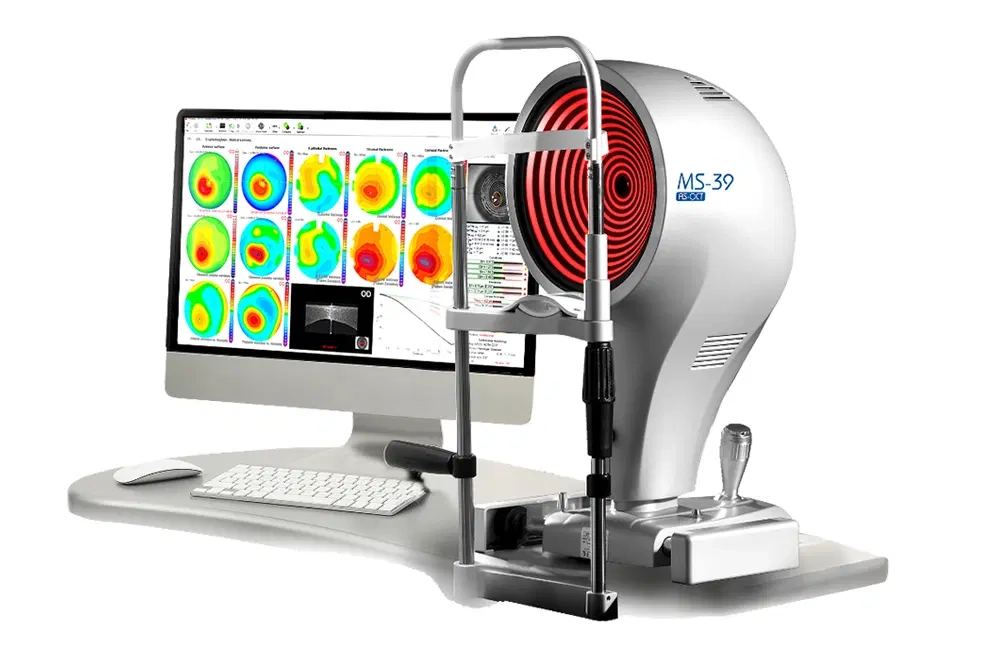
- Performing corneal mapping (Corneal Topography or Corneal Tomography) to determine corneal curvature and irregularity.
- Measuring corneal curvature and diameter.
- Evaluating corneal thickness and confirming the stability of the condition.
- Testing different lens designs inside the clinic to achieve an appropriate fit between the lens and cornea.
- Examining tear distribution beneath the lens using fluorescein dye to ensure there is no excessive pressure on the cornea.
- Reassessing the eye after wearing the lens to confirm stability, comfort, and vision quality.
After selecting the appropriate design, the patient may need more than one visit to adjust the measurements of scleral lenses for keratoconus accurately, especially in advanced cases or when using scleral lenses. Even a small difference in measurements can affect comfort and visual clarity.
Dr. Fouad El Sayyad focuses on performing a comprehensive eye evaluation using advanced corneal imaging devices before prescribing scleral lenses for keratoconus, helping select the lens type that matches their condition.
Do Scleral Lenses Permanently Treat Keratoconus or Only Improve Vision?
One of the most common questions patients ask is whether scleral lenses for keratoconus can cure the disease permanently.
The answer is that scleral lenses do not treat the underlying problem of keratoconus or restore the cornea to its original shape. Instead, they improve vision by compensating for corneal irregularities, allowing many patients to experience noticeable improvement in visual quality once they wear the lenses.
If keratoconus is still progressing, the doctor may recommend corneal cross-linking to slow down or stop disease progression. After the condition becomes stable, keratoconus treatment lenses can be used to achieve favorable outcomes.
Some patients with very advanced keratoconus may require a corneal transplant if lenses or other treatments can no longer provide adequate vision or if severe corneal scarring occurs.
Therefore, the treatment plan differs from one patient to another and is determined based on the severity of keratoconus and the results of eye examinations.
Can Scleral Lenses Be Used After Corneal Cross-Linking?
Yes, in many cases, scleral lenses for keratoconus can be used after corneal cross-linking. In fact, many patients require these lenses to achieve clearer vision after the procedure.
It is important to understand that corneal cross-linking aims to stop disease progression, but it does not completely restore the cornea to its normal shape. Therefore, corneal irregularity may remain even after successful treatment, and this is where scleral lenses for keratoconus help improve visual quality.
The lenses are not usually fitted immediately after surgery. Instead, the doctor waits until the cornea has fully healed and the measurements become stable. The recovery period varies from one patient to another depending on healing speed and follow-up results.
Before prescribing keratoconus treatment lenses after cross-linking, the doctor repeats corneal mapping and measurements because the shape of the cornea may change after the procedure, requiring a new customized lens design.
Read more about Cataract surgery for the elderly
What Is the Price of Scleral Lenses for Keratoconus in Egypt and What Factors Affect the Cost?
The cost of rigid and scleral lenses for keratoconus in Egypt varies from one patient to another depending on the type of lens used, whether Rigid Gas Permeable (RGP) or scleral lenses, as well as the lens design, the severity of keratoconus, and the shape of the cornea.
The final cost may also be affected by the complexity of the required measurements, the number of fitting and adjustment sessions, the materials used, and the individual needs of each eye. For this reason, the exact cost is determined after a detailed corneal examination and selection of the most suitable lens to provide a suitable balance between visual clarity, stability, and comfort.
Important Tips for Caring for Scleral Lenses and Avoiding Improper Use Risks
The success of scleral lenses for keratoconus depends not only on choosing the correct lens but also on proper usage and care.
Even when the lens is perfectly fitted, neglecting cleaning procedures or wearing it longer than recommended may increase the risk of eye infections, irritation, and reduced vision quality.
To maintain your scleral lenses for keratoconus and protect your eyes, follow these instructions:
- Wash your hands thoroughly with soap and water and dry them before touching the lenses.
- Use only the recommended cleaning and disinfecting solutions. Do not use tap water or saliva to clean lenses.
- Follow the wearing schedule recommended by your doctor, especially during the first weeks of use.
- Clean the lenses after every use and store them in a clean case with fresh solution daily.
- Replace the lens case regularly to reduce bacterial growth.
- Do not sleep while wearing lenses unless specifically recommended by your doctor in special cases.
- Stop using the lenses and consult your doctor if you experience severe pain, persistent redness, or sudden vision changes.
- Attend regular follow-up appointments to check whether your scleral lenses for keratoconus remain suitable as the shape of your cornea changes.
Following these instructions helps extend the lifespan of keratoconus lenses, maintain eye comfort, and reduce the possibility of complications caused by improper use.
Why Is Dr. Fouad El Sayyad the Right Choice for Prescribing and Fitting Keratoconus Lenses?
Selecting scleral lenses for keratoconus requires extensive experience in diagnosing keratoconus and a deep understanding of changes affecting the corneal surface. The success of these lenses depends on accurate measurements and choosing the right lens design for each patient, not only on the type of lens itself.
Dr. Fouad El Sayyad, Consultant of Ophthalmology and Eye Surgery and a Consultant ophthalmologist specializing in cornea, cataract and refractive surgery, certified by the American Board of Ophthalmology, relies on a comprehensive evaluation of each case before prescribing scleral lenses for keratoconus.
The evaluation process includes a complete eye examination, corneal mapping, lens trial and fitting, and follow-up after wearing the lenses to monitor visual outcomes and maintain corneal health.
The most important advantages of the treatment journey include:
- Accurate diagnosis using advanced devices to evaluate the corneal shape.
- Selecting the most suitable type of keratoconus treatment lenses according to the severity of the condition and the patient's needs.
- Customizing lenses based on precise eye measurements instead of relying on standard ready-made sizes.
- Regular follow-up after receiving the lenses to assess fit, stability, and eye comfort.
- Providing comprehensive treatment solutions, including conservative treatment, corneal cross-linking, or surgical options when necessary.
If you experience blurred vision due to keratoconus, early evaluation helps determine the right treatment at the right time, whether through scleral lenses for keratoconus or other available treatment options based on your condition.
Conclusion
Scleral lenses for keratoconus help many patients achieve clearer vision and perform their daily activities with greater confidence. However, successful results depend on accurate diagnosis, proper lens selection, and continuous medical follow-up.
Choosing the right keratoconus treatment lenses is not only about improving vision but also about maintaining eye health and assessing comfort and eye health during continued use.
If you are experiencing symptoms of keratoconus or having difficulty seeing clearly despite wearing glasses, you can schedule an appointment with Dr. Fouad El Sayyad for a comprehensive eye evaluation and to determine the most suitable keratoconus lenses or other treatment options that match your condition.
References
This article is for general education and does not replace an eye examination. Treatment decisions depend on your own eye assessment.
FAQS
-
How long should I wear hard contact lenses?
The duration of rigid contact lenses for keratoconus varies depending on the lens type, quality of care, and manufacturer's recommendations. They can last for several years if the patient maintains them and they remain a good fit for the eye's measurements. Regular follow-up appointments are necessary because changes in corneal shape may require lens adjustment or replacement.
-
Which lenses may be suitable for keratoconus?
There is no single lens that suits all patients. The choice depends on the degree of keratoconus, the shape of the cornea, and the examination results. RGP (rigid cross-linked) lenses may be suitable for some cases of keratoconus, while scleral lenses achieve better results in others. The doctor will determine the appropriate type after examination.

Book an Eye Consultation Appointment | Dr. Fouad El Sayyad
Book now