
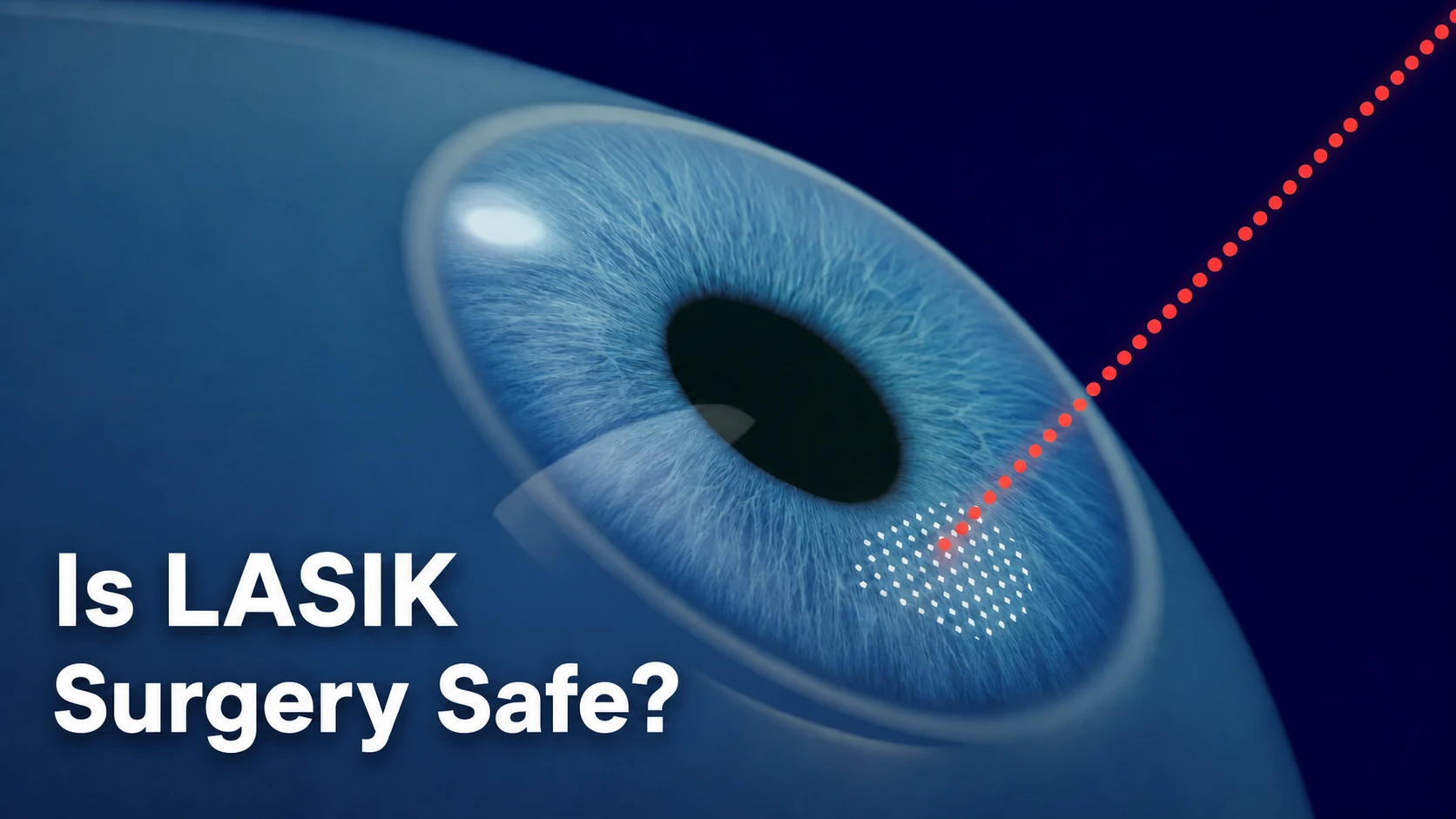
"Is LASIK surgery safe?" This is a question frequently asked by people who wish to get rid of eyeglasses and contact lenses and permanently restore clear vision. With the widespread adoption of vision correction procedures and the advancement of modern laser technologies, many people wonder about the safety of this procedure and the possibility of serious complications following it. Sometimes, people even ask questions like: Does vision correction surgery cause blindness?
In this article, we answer in detail the question of whether LASIK surgery is safe, explaining the factors that make it a high-success procedure, the cases for which it may not be suitable, potential risks and ways to prevent them, essential tips to achieve favorable outcomes, and finally, how to choose an experienced surgeon. Just keep reading until the end.
For a broader overview, see LASIK surgery requirements. For a related perspective, see LASIK surgery complications. For a related perspective, see Learn more about recovery time after lasik.
Is LASIK Surgery Safe?
LASIK surgery is considered a commonly used surgical option when performed on suitable cases and after undergoing meticulous examinations to evaluate eye health, corneal thickness, and vision stability—especially with the evolution of modern laser technologies that have helped raise success rates and significantly reduce the likelihood of complications, making LASIK a trusted choice to eliminate eyeglasses and contact lenses.
However, the level of safety does not depend on technology alone; it is also tied to accurate pre-operative diagnosis, how suitable the candidate is according to essential LASIK Surgery Requirements, and the surgeon's expertise, all of which help achieve optimal visual results and minimize potential side effects.
If you are still wondering whether LASIK surgery is safe for your condition and want to know When Can LASIK Surgery Be Performed?, do not hesitate to contact us at Sayyad Eye Center—Consultant of Ophthalmology, American Board Certified, and Specialist in Cornea, Cataract, and Refractive Surgeries—to book a specialized consultation and undergo a comprehensive eye exam to help you make the right decision and restore your clear vision safely and confidence.
What Makes LASIK Safe and Successful
In explaining whether LASIK surgery is safe, let us clarify that this procedure achieves high success and safety rates thanks to a combination of factors used to assess suitability and plan the procedure for each case. This is especially true with modern laser technologies and thorough pre-operative examinations that evaluate eye health and select the appropriate technology, contributing to optimal visual outcomes and reducing the chance of any complications. This can be detailed as follows:
The Role of Technological Advancement in Increasing the Safety of Vision Correction Surgeries
Modern laser devices and advanced eye-tracking systems have elevated the level of precision during LASIK procedures. They help correct refractive errors with high accuracy while preserving corneal tissue as much as possible. Furthermore, 3D corneal imaging and advanced measurement devices, alongside cutting-edge options like SMILE Pro (sometimes called Femto-SMILE), have improved surgical planning and reduced the likelihood of complications, significantly boosting success and safety rates.
The Importance of a Comprehensive Exam Before the Procedure to assess risks and plan care for each patient
A precise exam prior to LASIK surgery is one of the most vital factors in its success. It helps evaluate eye health, measure corneal thickness and vision stability, and detect any issues that might affect surgical results. It also helps determine patient suitability and choose the right technique, which minimizes potential risks and increases the chances of achieving stable and satisfying long-term visual results.
Therefore, the answer to the question "Is LASIK surgery safe?" always begins with selecting a specialized doctor and a center equipped with the latest technologies to ensure the operation is conducted according to procedures for patient assessment, surgical planning, and infection control.
According to the American Academy of Ophthalmology (AAO), approximately 90% of LASIK patients achieve vision between 20/20 and 20/40 without glasses or contact lenses. However, individual results may vary.
When Does LASIK Surgery Become Unsafe?
Although LASIK surgery is a commonly used surgical option, it may not be the right choice for every case. The answer to "Is LASIK surgery safe?" depends primarily on how suitable the health status of the eye and body is for this procedure. Therefore, the operation may become unsafe or unrecommended in certain cases that could affect the results or increase the risk of complications.
The most prominent cases that may not be suitable for LASIK include:
- Having certain autoimmune diseases or using immunosuppressive medications.
- Suffering from advanced stages of chronic dry eye.
- Instability in vision prescription in recent times due to pregnancy, breastfeeding, or certain medications.
- Having eye diseases or conditions such as keratoconus (where patients may explore alternatives like Rigid Lenses For Keratoconus), corneal infections, glaucoma, or cataracts (or seeking options prior to surgical intervention such as Treating Cataracts Without Surgery).
- Cases of severe myopia (nearsightedness) or hyperopia (farsightedness) that exceed the appropriate limits for LASIK.
- Individuals under the age of 18.
- Having an extremely thin cornea or abnormally wide pupils unsuitable for the procedure, where understanding The Difference Between LASIK And Surface Laser becomes vital in choosing a safer alternative.
For this reason, a comprehensive eye examination prior to the operation is an indispensable step. It helps determine the safety of LASIK for each condition and choose a suitable alternative if LASIK is not recommended.
How Does Dr. Fouad El Sayyad Assess Risks and Plan LASIK Care for His Patients?
In the context of addressing "Is LASIK surgery safe?", achieving precise and safe results begins with choosing the right doctor and a medical center equipped with the latest technologies. Therefore, at Sayyad Eye Center, we ensure the application of patient-safety and quality-control procedures across all treatment stages—starting from accurate diagnosis, through selecting the proper technique, to continuous post-operative follow-up to provide individual care and assess visual outcomes. This includes:
Using the Latest International Laser Technologies at Sayyad Eye Center
Sayyad Eye Center relies on the latest globally approved laser devices and corneal examination/diagnostic technology. This allows for measuring all eye details with high precision before surgery and planning the procedure to fit the unique nature of each case. These advanced techniques also enhance surgical precision and yield stable, safe visual results.
Dr. Fouad El Sayyad's Expertise in Handling Complex Cases
Dr. Fouad El Sayyad possesses extensive experience in refractive surgeries and diagnosing various conditions, enabling him to choose the proper technique for each patient based on the degree of vision impairment, corneal thickness, and overall eye health. We also place great emphasis on post-operative exams and follow-ups to support recovery and maintain optimal long-term vision quality.
If you wish to know whether LASIK surgery is safe and suitable for your condition, we invite you to contact us at Sayyad Eye Center to schedule your consultation and receive a precise evaluation to help restore your vision quality safely and confidently.
Comparison Between the Safety of LASIK Surgery and Contact Lenses
In discussing "Is LASIK surgery safe?", when comparing the safety of LASIK surgery to using contact lenses, we find that each option has distinct advantages and risks depending on usage habits and eye health:
- LASIK Surgery: A precise procedure aimed at permanently correcting vision defects. It generally provides stable vision without relying daily on external tools, while reducing inflammation risks associated with repeated lens use.
- Contact Lenses: Despite being easy to use without surgical intervention, continuous use can be associated with risks like dry eyes and infections if proper hygiene and usage guidelines are not strictly followed.
Therefore, choosing between them depends on the patient's lifestyle, eye condition, and whether a permanent or temporary vision correction solution is preferred—highlighting the importance of consulting a specialized ophthalmologist to determine an appropriate option for each case.
Does Vision Correction Surgery Cause Blindness?
No, vision correction surgery does not cause blindness. It is considered a safe procedure when performed after a precise case evaluation by a specialized surgeon like Dr. Fouad El Sayyad. These procedures rely on precise laser technologies that reshape the corneal surface to improve vision quality without affecting the eye's internal, sensitive structures.
However, some temporary side effects may appear after the surgery, such as dry eyes, sensitivity to light, or mild blurry vision, which usually improve gradually with adherence to medical instructions and regular follow-ups.
To confirm whether this procedure is suitable for you and whether LASIK is safe for your specific case, do not hesitate to contact us at Sayyad Eye Center to book a specialized consultation and comprehensive eye examination.
Potential Risks of LASIK Surgery and How to Prevent Them
After understanding whether LASIK surgery is safe, it can be said that LASIK is a relatively safe procedure. However, like any medical intervention, it may be accompanied by temporary or rare side effects that vary from person to person based on the eye's condition and pre-operative diagnostic accuracy. To learn more about this topic, you can read our guide on LASIK Surgery Complications. Key potential risks include:
1. Dry Eyes
Dry eye is one of the most common symptoms following LASIK, as tear production may temporarily decrease, causing a burning or stinging sensation.
- Prevention: Use moisturizing eye drops regularly, avoid direct air exposure (air conditioners or fans), and follow the doctor's instructions strictly.
2. Blurred Vision or Halos
Some patients may experience unfocused vision or halos around lights, especially at night, which is typically temporary.
- Prevention: Avoid night driving during the initial days, adhere to prescribed eye drops, and attend post-operative follow-up appointments.
3. Incomplete Vision Correction
In some cases, vision may not be 100% corrected, and the patient might require an additional corrective procedure.
- Prevention: Choose a trusted medical center, conduct thorough pre-operative exams, and ensure prescription stability prior to LASIK.
4. Eye Infections
Although rare, infections may occur due to a lack of sterilization compliance or post-operative care negligence.
- Prevention: Use prescribed antibiotics, avoid touching or rubbing the eyes, and maintain good hand hygiene.
5. Light Sensitivity
Some patients feel sensitive to light after the procedure, particularly during the first few days.
- Prevention: Wear sunglasses when going outdoors, reduce exposure to bright lighting, and give your eyes adequate rest.
6. Rare Complications (e.g., Permanent Vision Impairment or Corneal Issues)
In extremely rare cases, complications such as permanent vision loss or corneal problems may occur.
- Prevention: Choose an experienced specialist, ensure suitability for the procedure (not everyone is a candidate for LASIK), and fully comply with post-operative instructions.
Overall, these risks can be minimized, and stable, safe visual results can be achieved by adhering to thorough examinations, selecting the right doctor to determine if LASIK is safe for your case, and maintaining regular pre- and post-operative follow-ups for long-lasting visual clarity.
Dr. Fouad El Sayyad's Tips for a Safe Recovery Period After LASIK
Having answered "Is LASIK surgery safe?", the post-LASIK recovery period is just as crucial as the procedure itself. The quality of results and speed of recovery depend on strict adherence to medical guidance. At Sayyad Eye Center, we provide key guidelines to protect your eyes and safely accelerate visual stabilization:
- Use prescribed eye drops regularly at the designated times.
- Avoid rubbing your eyes completely during the first few weeks following the operation.
- Wear protective eyewear while sleeping or in crowded places when necessary.
- Limit direct screen exposure in the initial days to reduce eye strain.
- Avoid swimming or allowing water into the eyes during early recovery.
- Adhere to scheduled follow-up appointments with your doctor.
Following these instructions supports healing. Recovery time and visual outcomes vary between patients, and new or persistent symptoms should be discussed with the doctor.
Why Choose Dr. Fouad El Sayyad for LASIK Surgery?
Having explained whether LASIK surgery is safe, choosing the right doctor is the most critical step to planning care and assessing individual risks, given the variety of techniques and case differences. At Sayyad Eye Center, we offer an integrated medical experience based on precise diagnosis and state-of-the-art vision correction technologies. Key highlights of our practice include:
- Comprehensive and meticulous pre-operative evaluation to determine the proper procedure type.
- Utilization of modern laser technologies in refractive surgeries.
- Extensive medical expertise in handling various degrees of refractive errors and complex cases.
- Clear consultations that help you understand the differences between techniques (such as Femto-LASIK, SMILE Pro, or PRK or specialized solutions like Presbyond Laser Blended Vision) to pick an appropriate fit.
- Diligent post-operative monitoring to monitor vision and support recovery.
- Ongoing commitment to achieving procedures for patient assessment, surgical planning, and infection control in all procedures.
In conclusion, LASIK surgery has become one of the most precise and safe vision correction procedures today, thanks to technological advancements and advanced pre-operative testing. However, the true key to success relies on accurate individual diagnosis, paired with an expert surgeon capable of choosing the optimal technique to minimize risks and maximize outcome.
If you are considering LASIK and looking for the right choice, do not let hesitation delay a step that could transform your quality of life. Reach out now to Sayyad Eye Center for a comprehensive evaluation and expert consultation to select your appropriate technique and step into clearer vision with safety and confidence.
References
This article is for general education and does not replace an eye examination. Treatment decisions depend on your own eye assessment.
FAQS
-
What happens if the LASIK procedure fails?
In rare cases, the LASIK procedure may not yield the fully expected outcome—such as the persistence of a minor degree of vision impairment or visual instability—but these situations can often be managed through medical follow-up or additional corrective procedures, as determined by the physician.
-
Are there any risks associated with the LASIK procedure?
LASIK surgery is generally considered safe; however, temporary symptoms such as dry eyes, light sensitivity, or mild blurred vision may occur during the recovery period. These symptoms usually improve gradually as the doctor's instructions are followed.

Book an Eye Consultation Appointment | Dr. Fouad El Sayyad
Book now