
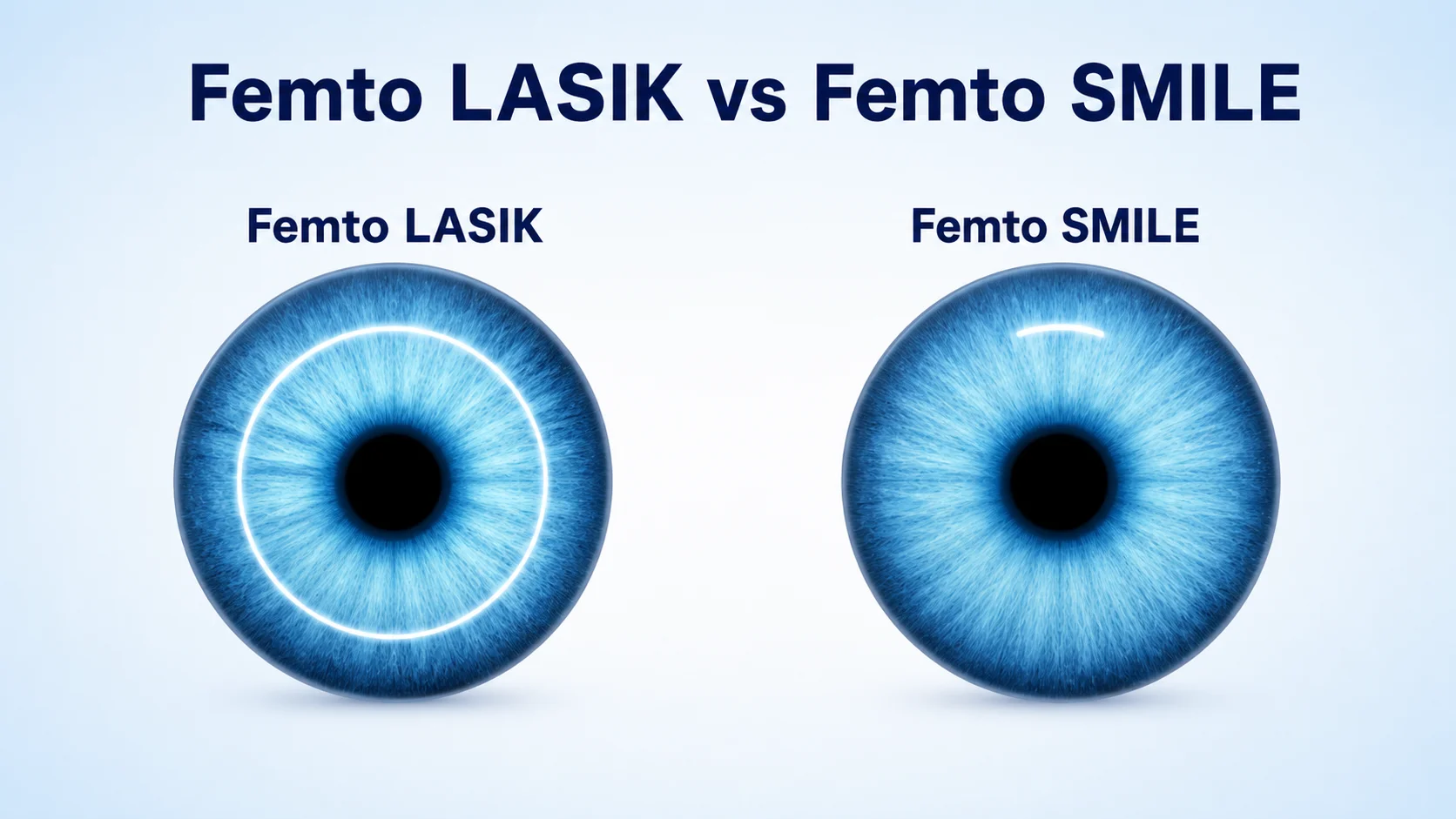
For a side-by-side comparison of all three procedures, see SMILE Pro vs LASIK vs PRK.
With the advancement of vision correction technologies, reducing dependence on glasses or contact lenses may be possible for suitable candidates. Among the options available, both Femto-LASIK and SMILE Pro (sometimes called Femto-SMILE) are two available procedures. However, many individuals wonder about the difference between Femto-LASIK and SMILE Pro to determine the most suitable option for their condition and achieve favorable outcomes.
In this article, we will cover the difference between Femto-LASIK and SMILE Pro in detail. We will explain how each technology works, their key advantages and disadvantages, candidate eligibility for each procedure, costs, and whether vision deteriorates after Femto-LASIK. Finally, we will guide you to a vision correction specialist to help you choose the right technique to restore your sight effectively and safely. Please read on to the end.
Difference Between Femto-LASIK and SMILE Pro: Which May Suit Your Eyes?
When considering vision correction surgery, you may find yourself comparing two of the latest and most widespread technologies: Femto-LASIK and SMILE Pro. Although both procedures aim to improve vision and eliminate reliance on glasses or contact lenses, each technique possesses unique characteristics that make it more suitable for specific cases over others.
Determining the appropriate procedure depends on several factors, such as the degree of refractive error, corneal thickness, the nature of the patient's daily activities, and pre-operative evaluation results. This makes distinguishing between Femto-LASIK and SMILE Pro an essential step toward reaching the right treatment decision and achieving optimal long-term visual outcomes. To understand how these techniques compare with other laser options, you can read more about Femto-LASIK, SMILE Pro, or PRK.
At the center of Dr. Fouad El Sayyad—Consultant of Ophthalmology, American Board certified, and specialist in cornea, cataracts, and vision correction surgeries—we prioritize thorough evaluations using state-of-the-art eye diagnostic tools. This helps determine the appropriate technique based on the eye's specific characteristics and requirements, supporting treatment planning and discussion of potential benefits and risks.
Contact Sayyad Eye Center now for precise advice on the difference between Femto-LASIK and SMILE Pro, and undergo a comprehensive examination to select the right procedure for your condition safely and accurately.
What Is Femto-LASIK Technology and How Does It Work?
When discussing the difference between Femto-LASIK and SMILE Pro, we must first understand Femto-LASIK, which is one of the newest and most precise laser vision correction methods. This technology utilizes two different types of laser beams to reshape the cornea and correct refractive errors without traditional surgical instruments, with suitability, risks, and recovery assessed for each patient.
Femto-LASIK relies on a precise mechanism that includes:
- Using a femtosecond laser to create a thin, precise flap on the corneal surface.
- Gently lifting this flap to access the underlying corneal tissues.
- Directing an excimer laser to reshape the cornea and correct refractive errors such as nearsightedness (myopia), farsightedness (hyperopia), or astigmatism.
- Adjusting corneal curvature according to the patient’s specific condition and degree of vision loss.
- Repositioning the surface flap naturally back into place after completing the correction.
What Is SMILE Pro Technology and What Are Its Main Benefits?
Further clarifying the difference between Femto-LASIK and SMILE Pro, SMILE Pro represents one of the latest advancements in vision correction. It uses laser energy to fix vision defects without needing a large surgical incision in the cornea, making it a good option for many people who want fast recovery and no corneal flap.
SMILE Pro relies on a femtosecond laser to create a small piece of tissue inside the cornea (lenticule), which is then extracted through a microscopic keyhole incision (about 2 mm), altering the cornea's shape to correct vision. Key benefits include:
- No need to create a corneal flap or large incision.
- Lower risk of dry eyes after surgery.
- Preserving corneal structural strength and lowering susceptibility to weakness or injury.
- Reduced discomfort and quick return to daily activities.
- Suitable for individuals seeking a minimally invasive procedure.
Key Core Differences Between Femto-LASIK and SMILE Pro
When comparing Femto-LASIK and SMILE Pro, both rely on advanced laser techniques, yet the fundamental difference lies in how the cornea is accessed and how refractive errors are corrected. This directly impacts recovery speed, surgical invasiveness, and long-term visual results.
Difference in Procedure Method and Corneal Preparation
Femto-LASIK uses a femtosecond laser to create a thin corneal flap, which is lifted so an excimer laser can reshape the inner tissue before replacing the flap. In contrast, SMILE Pro uses a more advanced technique where a tiny lens-shaped tissue (lenticule) is created inside the intact cornea and removed through a small incision without making a flap, minimizing surgical intervention and preserving more corneal structure.
Difference in Recovery Time and Vision Stabilization Speed
Femto-LASIK features rapid vision improvement within hours post-surgery, whereas SMILE Pro offers a more gradual visual recovery over the initial days. However, SMILE Pro reduces the incidence of dry eyes due to minimal disruption of superficial corneal nerves. Ultimately, both procedures yield stable, lasting results within a short timeframe. To learn more about post-operative care and healing expectations, see Recovery Time After LASIK.
Suitable Medical Cases for Each Technique
Femto-LASIK is widely applied to treat myopia, hyperopia, and varying degrees of astigmatism. SMILE Pro is primarily suited for cases of nearsightedness with or without specific degrees of astigmatism, especially for patients prone to dry eyes or those requiring maximum corneal stability.
Because choosing between Femto-LASIK and SMILE Pro is a precise medical decision based on corneal thickness, refractive errors, and overall eye health, relying on an experienced specialist with accurate diagnostic tools is important to support safe care and suitable outcomes.
Pros and Cons of Femto-LASIK and SMILE Pro
Both methods offer state-of-the-art results, yet each has specific pros and cons relative to individual eye conditions and patient needs.
1. Pros and Cons of Femto-LASIK
Pros:
- Quick, safe procedure with effective visual improvement results.
- Noticeable vision enhancement within a very short time frame.
- Recovery and discomfort vary between patients and should be discussed before the procedure.
- Quick return to work and daily routines.
- Strong, long-term visual acuity stability.
- Lowered chance of complications when using modern equipment.
Cons:
- May cause temporary dry eyes in some patients.
- Involves creating a corneal flap, which might increase corneal sensitivity post-surgery in certain cases.
- Cost may be relatively high compared to traditional alternatives.
- Unsuitable for patients with thin corneas or specific ocular conditions. To explore potential risks and preventive measures, read LASIK Surgery Complications.
2. Pros and Cons of SMILE Pro
Pros:
- Modern flapless technology.
- Decreased likelihood of dry eyes post-procedure compared to other techniques.
- Better preservation of corneal strength and biomechanical integrity.
- Reduced risk of surgical flap-related complications.
- Suitable for patients requiring minimal corneal tissue disruption.
Cons:
- Does not treat all ranges of refractive errors.
- Unsuitable for farsightedness (hyperopia).
- Higher cost compared to some other laser procedures.
- Requires a high level of surgical expertise.
- Not available at all medical facilities.
Consulting a specialized ophthalmologist to review these differences based on corneal thickness and refractive errors is crucial. Contact Sayyad Eye Center for a precise diagnosis to select the right solution safely.
Candidacy and Conditions for Femto-LASIK and SMILE Pro
Candidacy depends on specific medical criteria evaluated through comprehensive eye exams and corneal thickness measurements. If you want to check if you are ready for vision correction, explore When Can LASIK Surgery Be Performed?.
Conditions for Femto-LASIK
Femto-LASIK is a suitable option under the following conditions:
- Age 18 years or older.
- Nearsightedness between roughly -1.0 to -10.0 diopters.
- Farsightedness between +1.0 to +4.0 diopters.
- Astigmatism up to ±4.0 diopters.
- Stable vision prescription for at least one year.
- Adequate corneal thickness and shape.
- Absence of contraindicating eye or corneal diseases.
Conditions for SMILE Pro
SMILE Pro is an effective choice under the following conditions:
- Preferably 22 years of age or older.
- Stable vision prescription for at least 12 months.
- Nearsightedness ranging from -1 to approximately -10 diopters.
- Astigmatism up to approximately 5 diopters.
- Healthy cornea with suitable thickness.
A medical evaluation helps assess risks and the visual improvement that may be expected for each candidate.
Which Is Better: Femto-LASIK or SMILE Pro?
There is no single "better" technique for every case. Both deliver excellent vision correction outcomes; selection depends entirely on eye measurements, corneal thickness, error degree, and individual patient needs.
Femto-LASIK may suit selected patients needing broad refractive error correction with rapid visual recovery. SMILE Pro stands out for its minimally invasive nature, making it a great option for preserving corneal structural integrity and minimizing dry eye symptoms.
Final determination requires thorough pre-operative testing and a surgeon's clinical diagnosis.
Femto-LASIK Price vs. SMILE Pro Price in Egypt 2026
When comparing Femto-LASIK and SMILE Pro prices in Egypt, the cost varies according to the technique used, the patient's eye condition, and the results of the preoperative examinations. Femto-LASIK costs approximately EGP 35,000–45,000 and SMILE Pro approximately EGP 48,000–60,000, both for both eyes.
These prices are estimates rather than fixed costs for every patient. The final price may vary depending on the degree of refractive error, corneal thickness and topography, the patient's suitability for each procedure, and the examinations required before surgery.
Therefore, the choice between Femto-LASIK and SMILE Pro should not be based on price alone. A comprehensive eye examination is necessary to determine the most appropriate technique and the final cost for each individual case.
Cost varies depending on diagnostic accuracy, vision error complexity, laser devices used, and facility standards. For a detailed breakdown of procedure costs and pricing factors, check LASIK Surgery Price In Egypt.
My Experience with SMILE Pro
Patient reviews for this procedure will be added here.
SMILE Pro Failure and Complications
While SMILE Pro boasts high success rates, rare cases may experience less-than-expected improvements or unstable symptoms requiring early medical follow-up.
Key signs of unsatisfactory results or issues:
- Persistent blurriness or gradual regression over time.
- Night vision difficulties, halos, or visual glare.
- Unstable, fluctuating vision.
- Severe, persistent eye dryness.
If these symptoms occur, consult a specialist like Dr. Fouad El Sayyad immediately. Diagnostic precision before surgery remains the single most critical factor in avoiding complications.
Does Vision Deteriorate After Femto-LASIK?
In most instances, Femto-LASIK provides long-lasting, stable vision correction without regression, provided the candidate meets all medical criteria. If safety is a primary concern for you, check Is The LASIK Procedure Safe?.
In rare cases, slight visual changes over time may stem from natural aging, high initial refractive errors, or pre-existing instability before surgery—rather than failure of the procedure itself. Thorough pre-operative evaluation with an experienced specialist helps prevent future vision shifts.
Why Choose Dr. Fouad El Sayyad for Vision Correction Surgery?
Selecting the right surgeon is crucial for long-term safety and visual clarity. Sayyad Eye Center offers an integrated medical experience focusing on diagnostic accuracy, surgical skill, and modern technology. Key features include:
- Comprehensive evaluation using modern corneal topography and diagnostic tools.
- Clear consultations explaining differences between Femto-LASIK, SMILE Pro, and other laser options.
- Extensive expertise in vision correction, corneal care, and cataract surgery.
- Laser technology used alongside careful measurements and surgical planning.
- Attentive pre- and post-operative follow-up care for swift recovery.
- Tailored treatment plans customized to individual patient needs.
Prices are approximate, quoted in Egyptian pounds, and may change with exchange rates and the cost of imported lenses and supplies. The final cost is confirmed after a full eye examination.
References
This article is for general education and does not replace an eye examination. Treatment decisions depend on your own eye assessment.
FAQS
-
Which is better, Femto-LASIK or SMILE Pro?
Neither technique is better for everyone. Femto-LASIK may suit a wider range of refractive errors, while SMILE Pro may be suitable for some cases of myopia and astigmatism. An appropriate option depends on a comprehensive eye examination.
-
What are the disadvantages of SMILE Pro?
SMILE Pro may not be suitable for all refractive errors and is generally not used to correct hyperopia. Visual recovery can be gradual, and the procedure requires specialized equipment and surgical expertise.
-
What is an appropriate vision-correction technique?
An appropriate vision-correction technique depends on each eye’s condition, including the refractive error, corneal thickness and shape, eye-surface health, and the presence of dry eye or other conditions. A comprehensive examination is essential before choosing a procedure.
-
What is SMILE Pro?
SMILE Pro is a modern vision-correction technique that uses a femtosecond laser to create a small lens-shaped piece of tissue inside the cornea, which is removed through a tiny incision without creating a corneal flap.

Book an Eye Consultation Appointment | Dr. Fouad El Sayyad
Book now