
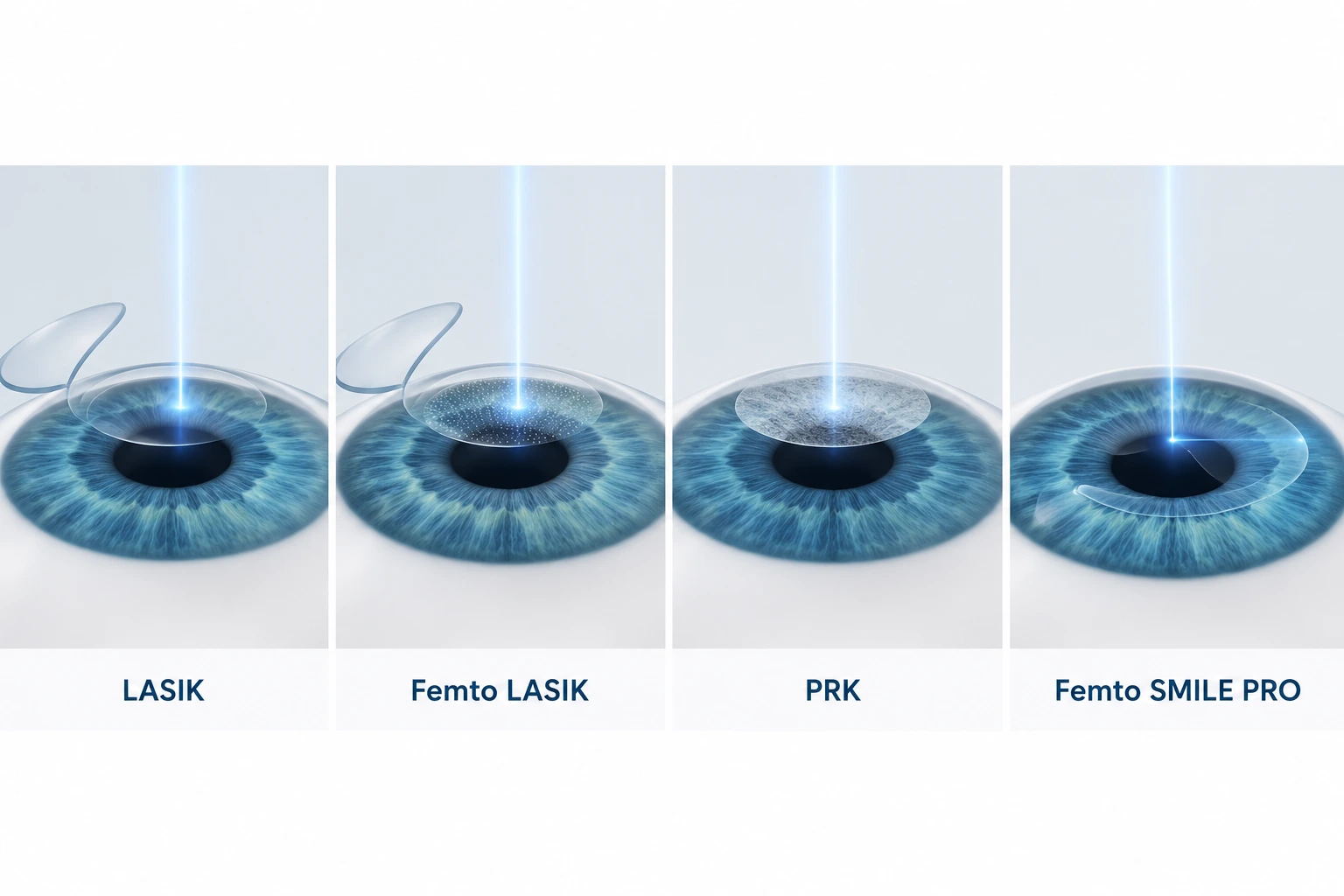
If you are considering laser vision correction, you may be asking: Should I have Femto-LASIK, Femto-SMILE, or PRK?
The answer is not the same for every patient. There is no single laser eye surgery procedure that is best for everyone. Each technique has its own advantages, limitations, recovery profile, and ideal candidates.
The right procedure depends on several factors, including your prescription, corneal thickness, corneal shape, tear film quality, age, lifestyle, and expectations. This is why a detailed eye examination and advanced corneal imaging are essential before deciding which procedure is safest and most suitable for your eyes.
In this article, we explain the difference between Femto-LASIK, Femto-SMILE, and PRK, when each option may be recommended, and why proper screening is the most important step before laser vision correction.
Related reading: the difference between femto lasik and femto smile: key details; Learn more about presbyond laser blended vision.
What Is Laser Vision Correction?
Laser vision correction procedures are designed to reduce dependence on glasses or contact lenses by reshaping the cornea, which is the clear front surface of the eye.
The cornea plays a major role in focusing light inside the eye. When a person has myopia, hyperopia, or astigmatism, light does not focus perfectly on the retina, causing blurred vision. Laser treatment changes the shape of the cornea so that light can focus more accurately.
Modern laser vision correction options include:
- Femto-LASIK
- Femto-SMILE or SMILE Pro
- PRK, also known as surface laser treatment
All three procedures can be excellent choices when used in the right patient. The key is choosing the correct procedure for the correct eye.
What Is Femto-LASIK?
Femto-LASIK is one of the most commonly performed modern laser vision correction procedures. In this technique, a femtosecond laser is used to create a thin corneal flap. The flap is gently lifted, and an excimer laser is used to reshape the cornea according to the patient’s prescription. The flap is then repositioned.
Femto-LASIK is known for fast visual recovery, minimal discomfort in most patients, and a quick return to daily activities when the patient is a suitable candidate.
However, Femto-LASIK is not suitable for everyone. The cornea must have adequate thickness, a healthy shape, and no signs of keratoconus or corneal weakness.
Learn more about LASIK doctor in Cairo
Advantages of Femto-LASIK
Femto-LASIK may offer several advantages in suitable patients:
- Accurate creation of the corneal flap using femtosecond laser technology
- Fast visual recovery in many cases
- Suitable for a wide range of myopia, astigmatism, and hyperopia cases
- Usually minimal discomfort after surgery
- Quick return to work and routine activities for many patients
- Long track record when performed after proper screening
Despite these advantages, Femto-LASIK should only be performed when the cornea is suitable and the overall eye examination is reassuring.
What Is Femto-SMILE?
Femto-SMILE, also known as SMILE, stands for Small Incision Lenticule Extraction. SMILE Pro is the newer version of this procedure performed using advanced femtosecond laser technology such as the ZEISS VisuMax 800.
Unlike Femto-LASIK, Femto-SMILE does not involve creating a corneal flap. Instead, the femtosecond laser creates a thin, lens-shaped piece of tissue inside the cornea. This tissue is called a lenticule. The surgeon then removes the lenticule through a small incision. Removing the lenticule reshapes the cornea and helps correct vision.
Femto-SMILE is commonly used for selected patients with myopia and astigmatism. It is a flapless procedure, which may be an advantage for certain patients. However, it is not suitable for every prescription or every corneal shape.
Advantages of Femto-SMILE
Femto-SMILE may offer several advantages in suitable patients:
- Flapless laser vision correction
- Small incision approach
- Suitable for selected cases of myopia and astigmatism
- May be preferred by some patients who want to avoid a flap-based procedure
- SMILE Pro with the VisuMax 800 offers a very fast laser step in eligible cases
- May help preserve the corneal surface structure compared with flap-based procedures
However, Femto-SMILE should not be chosen only because it is newer. The decision must be based on prescription, corneal thickness, corneal shape, tear film status, and full eye assessment.
Learn more about The difference between LASIK and surface laser
What Is PRK?
PRK, or photorefractive keratectomy, is a surface laser vision correction procedure. It does not involve creating a corneal flap, and it does not involve removing a lenticule from inside the cornea.
In PRK, the very thin surface layer of the cornea is removed, and an excimer laser reshapes the corneal surface. A temporary bandage contact lens is then placed on the eye for several days while the surface heals.
PRK is not an inferior procedure. In selected patients, it may actually be the safest or most appropriate option.
When May PRK Be Recommended?
PRK may be recommended in situations such as:
- Some patients with relatively thinner corneas
- Patients where creating a flap is not preferred
- Certain athletes or people at higher risk of eye trauma
- Selected cases where surface laser treatment is more appropriate
- Patients who are not ideal candidates for Femto-LASIK or Femto-SMILE
The main difference with PRK is recovery. Healing is usually slower than Femto-LASIK or Femto-SMILE. Patients may experience burning, tearing, light sensitivity, discomfort, and blurry vision during the first few days. Visual stability may also take longer.
Simple Comparison: Femto-LASIK vs Femto-SMILE vs PRK
Femto-LASIK
Femto-LASIK involves creating a thin corneal flap using a femtosecond laser, followed by corneal reshaping using an excimer laser. It is known for fast visual recovery and is suitable for many patients when the cornea is healthy and thick enough.
Femto-SMILE
Femto-SMILE is a flapless procedure. A small lenticule is created inside the cornea and removed through a small incision. It may be suitable for selected patients with myopia and astigmatism.
PRK
PRK is a surface laser treatment with no flap. The corneal surface is treated directly with an excimer laser. It may be preferred in selected patients, especially when avoiding a flap is important, but recovery is usually slower.
Femto-LASIK vs Femto-SMILE
The main difference between Femto-LASIK and Femto-SMILE is the surgical approach.
Femto-LASIK uses a corneal flap. After the flap is created, the excimer laser reshapes the cornea.
Femto-SMILE does not require a flap. Instead, the laser creates a lenticule inside the cornea, and the surgeon removes it through a small incision.
Femto-SMILE may be suitable for some patients with myopia and astigmatism. Femto-LASIK may offer more flexibility in treating a wider range of refractive errors depending on the case.
The question should not be, “Which one is newer?”
The better question is, “Which one is safer and more suitable for my eyes?”
Femto-SMILE vs PRK
Femto-SMILE is performed through a small incision without removing the corneal surface layer. For many patients, recovery is faster than PRK.
PRK treats the corneal surface directly. Because the surface layer needs time to heal, patients may experience more discomfort and slower visual recovery in the first few days.
However, PRK may be more appropriate in certain patients where Femto-SMILE or Femto-LASIK is not ideal. This depends on corneal thickness, corneal shape, prescription, and overall eye health.
Femto-LASIK vs PRK
Femto-LASIK involves creating a corneal flap, which usually allows faster visual recovery and less early discomfort.
PRK does not involve a flap. It treats the surface of the cornea directly. Recovery is slower because the surface needs to heal, but PRK may be safer or more suitable in selected cases.
For example, PRK may be considered in some patients with thinner corneas or in patients where a flap-based procedure is not preferred.
How Does the Surgeon Choose the Right Procedure?
Choosing the right laser vision correction procedure depends on several factors:
- Degree of myopia, hyperopia, or astigmatism
- Stability of the prescription
- Corneal thickness
- Corneal shape
- Screening for keratoconus or corneal weakness
- Tear film and dry eye status
- Pupil size
- Age
- Work requirements
- Sports and lifestyle
- Risk of eye trauma
- Patient expectations
A good refractive surgery assessment does not only answer whether a patient can have laser vision correction. It also determines which procedure is safest and most appropriate for that specific patient.
Learn more about LASIK surgery requirements
Why Corneal Mapping Is Essential Before Laser Vision Correction
Corneal mapping, also called corneal topography or tomography, is one of the most important tests before any laser vision correction procedure. It helps evaluate the shape, thickness, and structure of the cornea.
Some patients may have a prescription that appears suitable for surgery, but the corneal scan may show early signs of keratoconus, irregularity, or corneal weakness. In these cases, laser vision correction may not be safe.
Proper screening is the foundation of safe refractive surgery.
Is the Newest Procedure Always the Best?
No. This is one of the most important points for patients to understand.
Many patients assume that the newest technology must be the best option. In reality, the newest procedure is not always the most suitable one.
SMILE Pro is a modern and advanced option in selected patients. Femto-LASIK may be excellent for others. PRK may be the safest choice in specific cases.
The goal is not to choose the procedure with the most advanced name. The goal is to choose the safest and most effective procedure for each individual eye.
Who May Not Be Suitable for Laser Vision Correction?
Not every person who wears glasses is a candidate for laser vision correction. Some patients may not be suitable because of:
- Unstable prescription
- Keratoconus or suspected keratoconus
- Very thin corneas
- Significant uncontrolled dry eye
- Active eye disease
- Certain uncontrolled autoimmune conditions
- Pregnancy or breastfeeding in some situations
- Unrealistic expectations
In these cases, surgery may be delayed, avoided, or replaced by another option such as implantable contact lenses, depending on the patient’s condition.
Can Laser Vision Correction Eliminate Glasses Completely?
The goal of laser vision correction is to significantly reduce dependence on glasses or contact lenses. Many patients can perform most daily activities without glasses after surgery.
However, no refractive procedure can guarantee complete independence from glasses in every situation. Some patients may still need glasses for specific tasks, night driving, or fine visual work. Also, after the age of 40, many people develop presbyopia and may need reading glasses even if their distance vision is excellent.
Can Dry Eye Be Treated Before Surgery?
Yes. Dry eye is an important part of the preoperative assessment. Mild to moderate dryness can often be treated before surgery using lubricating drops and other treatments when needed.
If dry eye is severe or unstable, the surgeon may recommend delaying surgery or choosing a different procedure. Dry eye can affect comfort, healing, and quality of vision after laser vision correction.
When Does Vision Improve After Each Procedure?
After Femto-LASIK
Vision usually improves quickly, often within the first day or first few days. Mild fluctuation may occur early in the healing period.
After Femto-SMILE
Vision usually improves during the first few days. Some temporary fluctuation, glare, dryness, or mild blurriness may occur as the eye heals.
After PRK
Recovery is slower. The corneal surface needs several days to heal, and vision may take longer to stabilize compared with Femto-LASIK or Femto-SMILE.
Every patient heals differently, so follow-up visits are important after any procedure.
Frequently Asked Questions
Which is better: Femto-LASIK or Femto-SMILE?
There is no single answer for every patient. Femto-SMILE may be suitable for selected cases of myopia and astigmatism, while Femto-LASIK may be more suitable for other patients. The decision depends on the eye examination and corneal measurements.
Is PRK weaker than Femto-LASIK?
No. PRK is not weaker. It is simply different. In some patients, PRK may be the safer or more appropriate procedure, especially when avoiding a corneal flap is important.
Is Femto-SMILE suitable for everyone?
No. Femto-SMILE is not suitable for every prescription or every corneal shape. A full refractive surgery evaluation is required.
Can these procedures treat astigmatism?
Yes, many degrees of astigmatism can be treated with Femto-LASIK, PRK, or Femto-SMILE in suitable patients.
Are laser vision correction procedures painful?
The procedures are usually performed using numbing eye drops. Patients may feel pressure or mild awareness during surgery, but significant pain is not expected during the procedure. After surgery, discomfort varies by procedure and is usually more noticeable after PRK during the first few days.
Can I return to work quickly after surgery?
This depends on the procedure and your type of work. Many Femto-LASIK and Femto-SMILE patients return to desk work within a short time, while PRK usually requires a longer recovery period.
Can I use my phone after surgery?
You may use your phone after surgery, but it is usually better to reduce screen time during the early recovery period because the eyes may feel dry or sensitive. Lubricating drops and rest can help.
Can laser vision correction fail?
No medical procedure can guarantee a perfect result in every case. However, careful patient selection, accurate measurements, appropriate technology, and following postoperative instructions all help improve safety and outcomes.
How do I know which procedure is right for me?
The only way to know is through a full refractive surgery consultation. This includes refraction, corneal mapping, corneal thickness measurement, dry eye assessment, and a complete eye examination.
Conclusion
Femto-LASIK, Femto-SMILE, and PRK are all important laser vision correction procedures. Each has a specific role depending on the patient’s eyes.
Femto-LASIK is known for fast recovery and accurate flap creation using femtosecond laser technology.
Femto-SMILE is a modern flapless option that may be suitable for selected myopia and astigmatism cases.
PRK is a surface laser treatment that may be the safest option in certain patients, especially when avoiding a flap is preferred.
The most important step is not choosing a procedure based on popularity, advertising, or the newest name. The most important step is a detailed refractive surgery evaluation to determine which option is safest and most suitable for your eyes.

Book an Eye Consultation Appointment | Dr. Fouad El Sayyad
Book now