
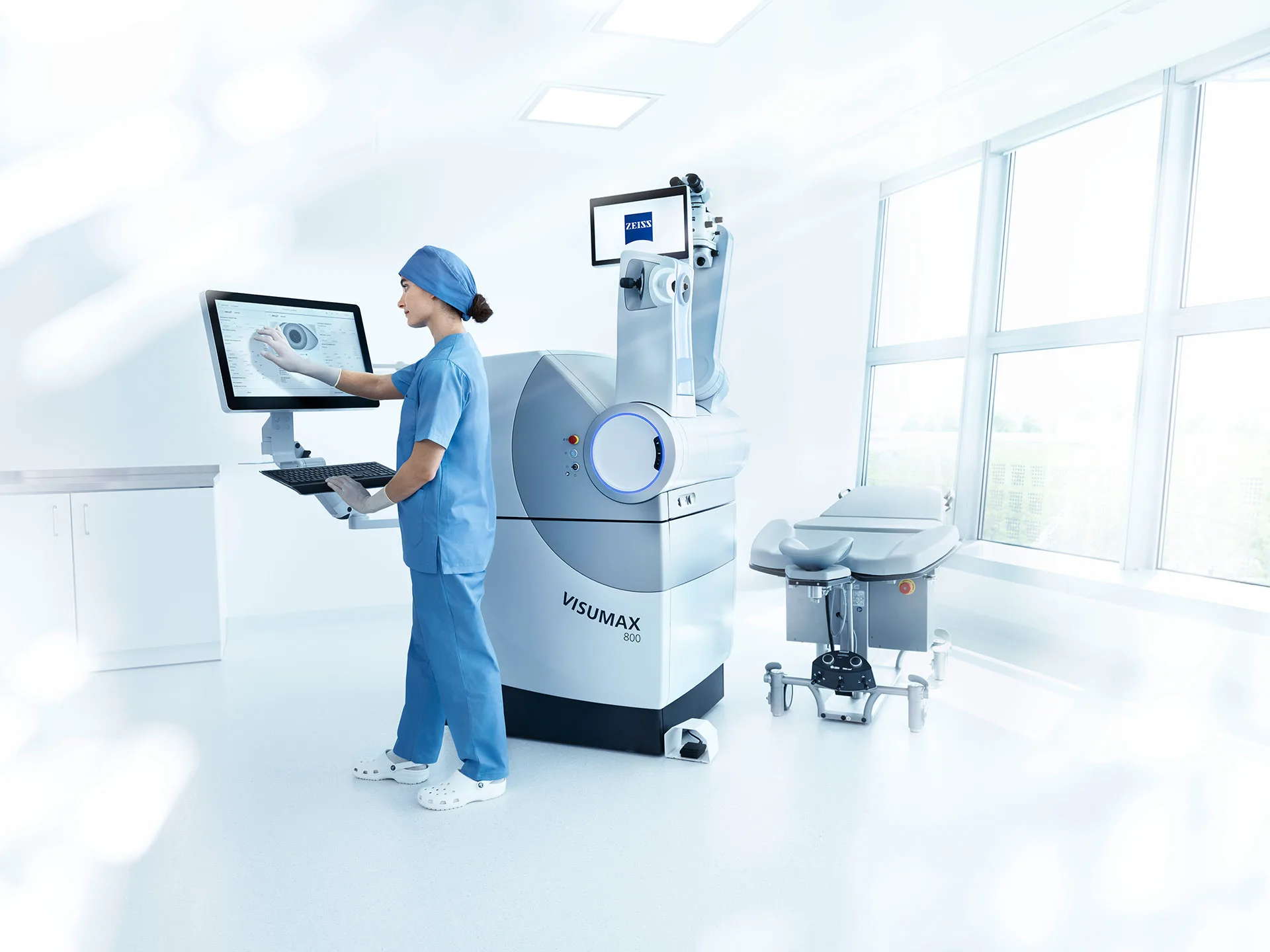
If you are considering laser vision correction and want a modern alternative to traditional LASIK, SMILE Pro may be one of the options discussed during your consultation. SMILE Pro is a minimally invasive laser vision correction procedure designed to correct certain cases of myopia, also known as nearsightedness, and astigmatism.
SMILE Pro is performed using the ZEISS VISUMAX 800, one of the latest femtosecond laser platforms for refractive surgery. The center is designed to provide advanced laser eye surgery in a premium medical setting, supported by detailed preoperative testing and careful patient selection.
Laser vision correction is not a one-size-fits-all procedure. The best option for each patient depends on several factors, including the prescription, corneal thickness, corneal shape, tear film quality, age, lifestyle, and eye health. This is why a complete refractive surgery assessment is essential before deciding whether SMILE Pro, Femto-LASIK, PRK, or another option is most suitable.
For a broader overview, see Learn more about lasik surgery requirements. For a related perspective, see Learn more about the difference between femto-lasik and femto-smile. For a related perspective, see The difference between LASIK and surface laser: key details.
What Is SMILE Pro?
SMILE Pro is a modern form of laser vision correction. The word SMILE stands for Small Incision Lenticule Extraction. In this procedure, a femtosecond laser creates a very thin, lens-shaped piece of tissue inside the cornea. This tissue is called a lenticule. The surgeon then removes the lenticule through a small incision, reshaping the cornea and helping light focus more accurately on the retina.
Unlike traditional LASIK or Femto-LASIK, SMILE Pro does not require the creation of a corneal flap. This is one of the main differences between SMILE Pro and flap-based laser vision correction procedures.
SMILE Pro is usually considered for suitable patients with myopia and astigmatism. However, not every patient is a candidate. A detailed eye examination and advanced corneal imaging are necessary to determine whether the procedure is appropriate and safe for the individual eye.
Learn more about LASIK safety and technology
How Is SMILE Pro Different from LASIK?
Both SMILE Pro and LASIK aim to reduce dependence on glasses or contact lenses by reshaping the cornea. However, the way they reshape the cornea is different.
In LASIK or Femto-LASIK, a thin flap is created on the surface of the cornea. The flap is lifted, an excimer laser reshapes the underlying corneal tissue, and the flap is then repositioned.
In SMILE Pro, there is no flap. Instead, the femtosecond laser creates the lenticule within the cornea, and the surgeon removes it through a small incision. Because the surface opening is smaller than a LASIK flap, SMILE Pro may be preferred in selected patients where a flapless approach is beneficial.
This does not mean that SMILE Pro is automatically better for everyone. Femto-LASIK, PRK, and SMILE Pro all have their roles. The correct choice depends on the patient’s corneal measurements, prescription, visual needs, and lifestyle.
Why the ZEISS VISUMAX 800 Matters
The ZEISS VISUMAX 800 is a high-performance femtosecond laser platform used for SMILE Pro. One of its important advantages is speed. The laser portion of the SMILE Pro procedure can be very fast, which may reduce suction time and help make the surgical experience more comfortable for eligible patients.
The VISUMAX 800 is part of a modern refractive surgery platform designed to improve precision, workflow, and patient experience. At Pro Vision, this technology is combined with detailed diagnostic testing and surgeon-led decision-making to choose the most appropriate laser vision correction procedure for each patient.
Advanced technology is important, but it is only one part of safe refractive surgery. The most important step remains proper patient selection. A modern laser should always be used together with careful examination, accurate measurements, and realistic patient counseling.
Who May Be Suitable for SMILE Pro?
SMILE Pro may be suitable for some patients who have myopia, with or without astigmatism, and who want to reduce their dependence on glasses or contact lenses.
A good candidate usually has:
- A stable glasses prescription
- Healthy corneas
- Adequate corneal thickness
- No signs of keratoconus or corneal weakness
- Good tear film and controlled dryness
- Realistic expectations about the procedure and recovery
- No active eye disease that would affect healing or visual outcome
Patients who play sports or prefer a flapless procedure may be interested in SMILE Pro, but suitability still depends on the clinical examination.
Some patients may be better suited for Femto-LASIK, PRK, ICL, or another treatment option. For example, patients with certain corneal shapes, significant dryness, very thin corneas, or prescriptions outside the safe treatment range may need a different plan.
What Happens During a SMILE Pro Consultation at ProVision?
The consultation before SMILE Pro is a critical part of the process. At ProVision, the aim is not only to determine whether the patient can have laser vision correction, but also to decide which procedure is safest and most appropriate.
The evaluation usually includes:
- Measurement of uncorrected vision
- Measurement of best corrected visual acuity
- Refraction to determine the exact prescription
- Corneal tomography and topography
- Corneal thickness assessment
- Screening for keratoconus and irregular corneal patterns
- Evaluation of the tear film and ocular surface
- Pupil assessment when needed
- Full eye examination to rule out other eye conditions
ProVision uses advanced diagnostic technology, including the CSO MS-39, which provides detailed analysis of the cornea. The center also uses modern biometry technology, such as the ZEISS IOLMaster 700, when lens and cataract-related measurements are required.
These tests help the surgeon understand the structure of the eye in detail before recommending SMILE Pro or another refractive procedure.
What Happens During the SMILE Pro Procedure?
On the day of surgery, the eye is numbed using anesthetic eye drops. The patient remains awake during the procedure, but the eye is comfortable. The surgeon positions the eye under the laser, and the patient is asked to look at a target light.
The ZEISS VISUMAX 800 creates the lenticule inside the cornea. The surgeon then removes this lenticule through a small incision. By removing this precisely shaped tissue, the cornea is reshaped to improve how light focuses inside the eye.
The procedure itself is usually quick, but patients should expect to spend more time at the center for preparation, checks, and postoperative instructions.
Recovery After SMILE Pro
Recovery after SMILE Pro is usually relatively fast, although every patient heals differently. Many patients notice improvement in vision within the first few days. Some fluctuation, mild dryness, glare, or halos may occur during the early healing period.
Patients are usually given eye drops after surgery, which may include antibiotic and anti-inflammatory drops, as well as lubricating drops. It is important to follow the postoperative instructions carefully and attend scheduled follow-up visits.
Patients should avoid rubbing their eyes after surgery and should follow their surgeon’s guidance regarding work, exercise, swimming, eye makeup, and screen use.
Is SMILE Pro Painful?
SMILE Pro is usually performed under topical anesthesia using numbing eye drops. Most patients feel pressure or awareness during the procedure rather than pain. Mild discomfort, tearing, foreign body sensation, or light sensitivity may occur after the procedure, especially during the first day.
The experience varies from person to person, but the procedure is generally well tolerated when performed in a calm setting with proper preparation and counseling.
Is SMILE Pro Safer Than LASIK?
SMILE Pro, Femto-LASIK, and PRK are all established laser vision correction options when used in the right patient. SMILE Pro has the advantage of being flapless, but that does not automatically make it the safest or best option for every case.
Safety depends on:
- Correct patient selection
- Accurate measurements
- Healthy corneal structure
- Stable prescription
- Proper surgical planning
- Surgeon experience
- Good postoperative care
Why Choose ProVision for SMILE Pro in New Cairo?
ProVision is located in Eterna Healthcare City in Mivida, New Cairo, in a premium medical environment designed for advanced refractive surgery. The center offers a modern laser vision correction platform, including SMILE Pro using the ZEISS VISUMAX 800, along with Femto-LASIK, PRK, and Presbyond Laser Blended Vision.
The strength of ProVision is not only the technology. It is the combination of advanced devices, detailed diagnostics, careful screening, and individualized treatment planning.
At ProVision, the goal is to recommend the procedure that best fits the patient’s eye, not simply to offer the newest option to everyone.
Learn more about LASIK specialist consultation in Cairo
SMILE Pro, Femto-LASIK, or PRK: How Do I Know Which One I Need?
Many patients come to the consultation asking for the newest procedure. While this is understandable, the newest procedure is not always the best choice for every eye.
SMILE Pro may be an excellent option for selected patients with myopia and astigmatism who are suitable for a flapless procedure. Femto-LASIK may be preferred in other cases because of its flexibility and fast visual recovery. PRK may be selected for certain patients where surface laser treatment is more appropriate.
The decision should be made after examining the cornea carefully and reviewing the patient’s visual goals, work requirements, lifestyle, and expectations.
Frequently Asked Questions About SMILE Pro
Is SMILE Pro the same as LASIK?
No. SMILE Pro and LASIK are both laser vision correction procedures, but they are performed differently. LASIK involves creating a corneal flap, while SMILE Pro is a flapless procedure that removes a lenticule through a small incision.
Is SMILE Pro better than Femto-LASIK?
Not necessarily. SMILE Pro may be better for some patients, while Femto-LASIK may be better for others. The best option depends on the prescription, corneal shape, corneal thickness, dryness, and lifestyle.
Can SMILE Pro treat astigmatism?
SMILE Pro can treat certain degrees of astigmatism in suitable patients. The exact suitability depends on the patient’s prescription and corneal measurements.
Does SMILE Pro treat hyperopia?
SMILE Pro is mainly used for myopia and astigmatism. Some platforms and markets may include expanded indications, but suitability depends on the approved treatment range and the surgeon’s assessment.
Conclusion
SMILE Pro is an advanced laser vision correction option for selected patients with myopia and astigmatism. Using the ZEISS VISUMAX 800, the procedure offers a modern flapless approach with fast laser treatment and a small incision.
At ProVision in Eterna Healthcare City, Mivida, New Cairo, SMILE Pro is part of a complete refractive surgery platform that also includes Femto-LASIK, PRK, and Presbyond Laser Blended Vision. The most important step is not simply choosing the newest technology, but choosing the right procedure for the right eye after detailed testing and careful surgical planning.
If you are considering SMILE Pro or laser vision correction in New Cairo, a complete refractive surgery assessment can help determine whether you are a suitable candidate and which option is safest for your eyes.

Book an Eye Consultation Appointment | Dr. Fouad El Sayyad
Book now