
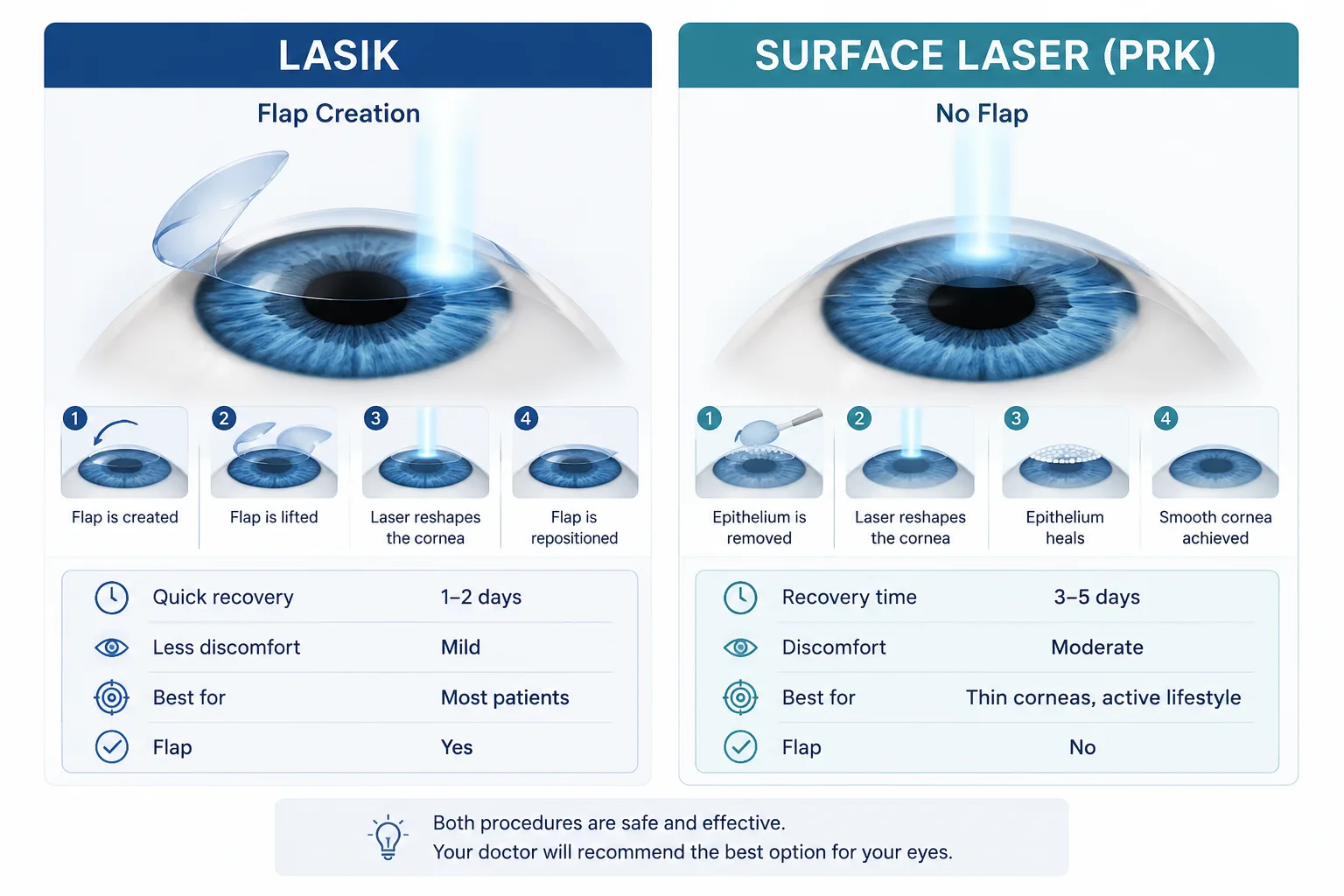
With the development of vision correction technologies, getting rid of prescription glasses and contact lenses has become a goal that is easier to achieve than ever before. Among the available options, LASIK and PRK stand out as two of the most common procedures for treating different refractive errors. However, many patients still wonder about the difference between LASIK and PRK and which option is more suitable for their condition to achieve the best results safely.
Although both procedures aim to improve vision and correct refractive errors such as myopia, hyperopia, and astigmatism, there are differences between them in terms of the procedure technique, recovery period, and suitability of each technology according to the nature of the cornea and eye condition. This makes choosing between them a medical decision that depends on accurate examination and comprehensive evaluation of each case.
In this article, we will explain in detail the difference between LASIK and PRK, how each technique works, the main advantages and disadvantages, the expected recovery period, the cost of each procedure, the conditions for laser eye surgery, the types of LASIK procedures and their prices, and other important details. Finally, we will guide you to the best doctor to help you choose the most suitable technique and restore your vision safely and confidently. Keep reading until the end.
For a broader overview, see Learn more about lasik surgery requirements. For a related perspective, see Learn more about the difference between femto-lasik and femto-smile. For a related perspective, see When can LASIK surgery be performed: key details.
Related reading: Femto-LASIK, Femto-SMILE, or PRK.
Difference Between LASIK and PRK: Which Is More Suitable for Correcting Your Vision?
When comparing different vision correction techniques, many patients ask about the difference between LASIK and PRK and which procedure provides better results. The truth is that both procedures aim to correct refractive errors and improve vision quality, but choosing between them mainly depends on the eye condition and the results of accurate medical examinations.
LASIK procedures are known for fast recovery and improved vision within a very short period after surgery. The accompanying symptoms are also limited in most cases and usually disappear within a few hours. PRK, on the other hand, may require a relatively longer recovery period, with gradual improvement in vision over the following days or weeks after the procedure.
However, one technique cannot be considered the best option for all cases. The final decision depends on the doctor’s diagnosis of each case according to several factors, including corneal thickness, the degree of refractive error, the nature of the eye, and how suitable each technique is for the patient.
At Dr. Fouad El-Sayyad Center, led by Dr. Fouad El-Sayyad, Consultant Ophthalmologist, holder of the American Board, and specialist in vision correction surgeries, we are committed to performing a comprehensive and accurate evaluation for each case using the latest eye examination devices. This helps you choose the appropriate technique while clearly explaining the difference between LASIK and PRK, as well as the types of LASIK procedures and their prices, to restore clear vision with confidence and safety.
Do not hesitate to contact us today at Dr. Fouad El-Sayyad Eye Center to book your consultation and undergo a comprehensive eye examination that helps you choose the best vision correction technique according to your condition and visual needs.
What Is LASIK Surgery and How Does It Work?
When discussing the difference between LASIK and PRK, LASIK is considered one of the most widely used vision correction techniques around the world. It aims to treat common refractive errors such as myopia, hyperopia, and astigmatism, helping the patient reduce dependence on prescription glasses or contact lenses and significantly improve vision quality.
LASIK is performed by creating a thin flap on the surface of the cornea, then using laser technology to precisely reshape the internal corneal tissue according to the patient’s degree of refractive error. The surface flap is then returned to its natural position. This provides fast visual results and a short recovery period compared with many other vision correction techniques.
With the development of vision correction surgeries, several advanced techniques have emerged under the different types of LASIK procedures and their prices. Choosing the appropriate technique depends on the nature of the eye and the results of medical examinations.
The most important of these techniques include:
Traditional LASIK
Traditional LASIK is one of the oldest types of LASIK. In this procedure, a microkeratome device is used to create the corneal flap, then the cornea is reshaped using laser. It is suitable for many cases and provides good results.
Epi-LASIK
Epi-LASIK is a technique that is close to PRK, where the thin outer layer of the cornea is separated without creating a deep flap, then laser is used to reshape the cornea. This technique is suitable for people with thin corneas, but it may require a relatively longer recovery period compared with traditional LASIK.
Femto-LASIK
Femto-LASIK is a more advanced technique in which a femtosecond laser is used instead of a surgical blade to create the corneal flap. This increases the accuracy of the procedure and reduces complications.
Femto-SMILE
Femto-SMILE is one of the latest vision correction techniques. It does not involve creating a flap. Instead, the shape of the cornea is corrected through a very small incision, which reduces dry eye and speeds up recovery.
Custom LASIK
Custom LASIK is a personalized technique for each patient. It depends on creating a precise eye map using wavefront technology, helping improve vision quality more accurately, especially in complex cases.
Therefore, choosing a vision correction technique is not based on personal preference only. It depends on a careful evaluation of the eye condition, corneal thickness, and degree of refractive error. This makes understanding the difference between LASIK and PRK, as well as other vision correction technologies, an important step toward achieving the best visual results with the highest levels of safety.
What Is PRK and How Does It Work?
Continuing our discussion about the difference between LASIK and PRK, PRK is one of the oldest and most well-known laser vision correction techniques. It is still used today with high efficiency to treat myopia, hyperopia, and astigmatism, especially in cases that are not suitable for some other LASIK techniques.
This technique depends on removing the thin surface layer of the cornea, known as the epithelium, then using excimer laser beams to reshape the surface of the cornea and correct refractive errors precisely, without the need to create a flap in the cornea as happens in some LASIK procedures.
After vision correction is completed, a temporary medical contact lens is placed on the surface of the eye to help protect the cornea and speed up healing of the surface layer during the first few days after the procedure. This layer regenerates naturally over time.
For this reason, PRK is considered a suitable option for some patients who have thin corneas or whose eye condition does not allow certain LASIK techniques. Therefore, choosing between PRK and other procedures depends on accurate examination and the evaluation of a specialized doctor for each case.
Key Differences Between LASIK and PRK
When discussing the difference between LASIK and PRK, we find that both techniques aim to correct vision and improve visual quality. However, there are clear differences between them in terms of the method of performance, recovery period, and speed of results. This makes choosing the right technique closely related to the eye condition and the results of accurate medical examinations.
These differences can be explained as follows:
Difference Between LASIK and PRK in Terms of Procedure Steps
The main difference between the two techniques lies in how the corneal surface is handled during surgery.
First: PRK Procedure Steps
- Removing the thin surface layer of the cornea, known as the epithelium.
- Using excimer laser beams to reshape the corneal surface and correct refractive errors.
- Placing a therapeutic contact lens to protect the eye after the procedure.
- Allowing the cornea to heal and the surface layer to regenerate gradually over the following days.
Second: LASIK Procedure Steps
- Creating a thin flap from the corneal surface.
- Temporarily lifting the surface flap to access the internal corneal tissue.
- Using laser technology to reshape the cornea and correct vision.
- Returning the surface flap to its natural position without the need for stitches.
Difference Between LASIK and PRK in Recovery Period and Speed of Results
Recovery speed is one of the most important differences between the two techniques. LASIK is known for rapid improvement in vision within only one or two days in most cases, with limited discomfort after the procedure.
PRK, however, usually requires a relatively longer recovery period. Vision may take from 7 to 14 days to improve, and the patient may feel more discomfort during the first few days compared with LASIK, before vision begins to improve gradually.
Difference Between LASIK and PRK in Terms of Cost in Egypt
The cost of both techniques varies according to several factors, including the type of technology used, the devices available inside the medical center, the degree of refractive error, and the experience of the treating doctor. LASIK surgery is usually relatively higher in cost compared with PRK because it uses more advanced techniques, provides faster recovery, and offers greater accuracy in results, in addition to more comfort for the patient after the procedure.
PRK is often lower in cost in many cases because it is a relatively older technique and less complex in terms of procedural steps. However, it may require a longer recovery period and closer medical follow-up during the first few days after the procedure.
Nevertheless, you should not depend on cost only when comparing the difference between LASIK and PRK. The focus should be on accurately evaluating the case to choose the most suitable technique in terms of safety and long-term results.
Because choosing the right technique does not depend on cost alone, but rather on accurate diagnosis of the eye condition, we invite you to contact Dr. Fouad El-Sayyad Center to book your consultation and receive a comprehensive evaluation that helps you understand the difference between LASIK and PRK, choose the suitable technique, and restore clear vision with the highest levels of safety.
When Is PRK a Better Option Than LASIK?
When discussing the difference between LASIK and PRK, we find that choosing the right technique depends on a precise evaluation of the eye condition, corneal thickness, and the degree of refractive error. PRK may be the safer option in the following cases:
- Having a thin cornea that does not allow creating a flap as in LASIK.
- Unsuitable corneal shape or condition for techniques that depend on lifting an internal corneal flap.
- Practicing sports or activities where the eye may be exposed to friction or trauma, making LASIK less safe.
- Wanting a treatment option that preserves corneal structure as much as possible without deeper surgical intervention.
- Cases where the relatively longer recovery period does not represent a problem for the patient.
If you would like to know the suitable technique for your case and receive an accurate consultation about the difference between LASIK and PRK, do not hesitate to contact Dr. Fouad El-Sayyad Center to evaluate your condition carefully and determine the appropriate technique to ensure the best visual result and restore clear vision safely.
Advantages and Disadvantages of LASIK Surgery
After understanding the difference between LASIK and PRK, we find that LASIK is one of the most common and successful vision correction techniques. It helps improve vision quality quickly and reduces dependence on glasses or contact lenses. However, like any medical procedure, it has a set of advantages and disadvantages that should be understood before making a decision.
Advantages of LASIK
- Fast and noticeable improvement in vision within a short time.
- A relatively simple procedure with a short recovery period.
- Reduced dependence on glasses and contact lenses.
- Stable results when suitable cases are selected.
Disadvantages of LASIK
- Possibility of temporary dry eye after the procedure.
- Light sensitivity or halos around lights in some cases.
- Not suitable for all corneal conditions or degrees of refractive error.
In general, LASIK remains an effective option for those seeking clearer vision within a short period. However, the final decision depends on a precise evaluation of the eye condition to choose the most suitable technique for each case. Do not hesitate to contact Dr. Fouad El-Sayyad Center to book a specialized consultation and let us help you restore clear vision effectively.
Advantages and Disadvantages of PRK
In the context of discussing the difference between LASIK and PRK, PRK is considered an effective technique for vision correction, especially for cases that are not suitable for some LASIK procedures. It depends on directly reshaping the surface of the cornea, making it a suitable option for certain groups of patients.
The advantages and disadvantages of this technique can be explained as follows:
Advantages of PRK
- Suitable for cases with thin corneas.
- Does not require creating a flap inside the cornea as in LASIK.
- Reduces some risks associated with flap-based techniques.
- Suitable for some athletes or professions where the eye may be exposed to pressure or injury.
Disadvantages of PRK
- Longer recovery period compared with LASIK.
- Discomfort or pain during the first few days after the procedure.
- Vision improvement is gradual rather than immediate.
- Requires accurate follow-up during the healing period until vision stabilizes.
Therefore, PRK is a safe and effective option in specific cases that require accurate selection of the most suitable technique. Do not hesitate to contact Dr. Fouad El-Sayyad Center to know the best option for your condition among vision correction techniques and restore your vision with the highest levels of safety.
My Experience With PRK
After understanding the difference between LASIK and PRK, PRK is considered one of the experiences that gives the patient gradual improvement in visual clarity after a period of poor vision or visual instability. Many cases confirm that “my experience with PRK was a turning point toward restoring vision quality safely and effectively, with noticeable improvement that begins gradually until the best possible visual result is achieved.”
Of course, the success of this experience depends mainly on accurate diagnosis, choosing the right doctor, and selecting a medical center equipped with the latest technologies.
At Dr. Fouad El-Sayyad Center, led by Dr. Fouad El-Sayyad, Consultant Ophthalmologist, holder of the American Board, and specialist in vision correction surgeries, patients receive precise medical care and extensive experience in performing vision correction procedures using the latest devices and technologies. This helps achieve outstanding visual results with the highest levels of safety and comfort during the recovery period.
How Does the Doctor Determine the Most Suitable Procedure for Your Case?
After understanding the difference between LASIK and PRK, the type of vision correction procedure suitable for each case is determined after a comprehensive and accurate evaluation of the eye through a set of precise examinations to ensure that the safest and most effective procedure is selected for each individual case.
At Dr. Fouad El-Sayyad Center, we rely on several advanced examinations to evaluate the eye condition accurately, including:
- Measuring the current degree of vision and comparing it with previous measurements to confirm vision stability.
- Performing a comprehensive corneal examination to determine its thickness and suitability for the type of procedure.
- Performing corneal topography to assess the shape and curvature of the cornea accurately.
- Examining the eye lens to ensure it is healthy and free from any opacity.
- Measuring eye pressure to make sure it remains within normal levels.
- Examining the fundus and optic nerve to ensure their safety.
- Evaluating the retina to detect any problems such as leakage or peripheral weakness.
- Reviewing the patient’s medical history, such as dry eye or previous corneal diseases.
Based on these results, Dr. Fouad El-Sayyad Center ensures a clear explanation of the difference between LASIK and PRK and other vision correction techniques, while determining the most suitable technology for each case to guarantee the highest levels of safety and accuracy in results.
Conditions for Laser Eye Surgery
Before undergoing vision correction surgeries, the doctor relies on a set of basic conditions that determine the safety and success of the procedure, especially when comparing the difference between LASIK and PRK and other techniques. Accurate evaluation helps choose the most suitable technique for each case and achieve the best possible visual result.
The most important conditions for laser eye surgery include:
- The patient should be 18 years old or older.
- Vision measurements should be stable for at least one full year.
- Corneal thickness should be suitable for the procedure.
- The eye should be free from inflammation or diseases such as keratoconus.
- There should be no severe dry eye that may affect the results.
- The patient should not be pregnant or breastfeeding during the procedure period.
- Certain acne medications, especially those containing isotretinoin, should be stopped for a sufficient period before the procedure, as they may affect eye dryness and corneal healing after LASIK.
- The degree of myopia or hyperopia should be within the range that can be treated with laser.
- The patient should have good general health that supports normal eye healing.
Therefore, meeting these conditions not only helps ensure the success of the procedure, but also helps choose the appropriate technique according to the evaluation of the specialist doctor, leading to clearer vision and safe results that last for a long time.
Fouad El-Sayyad: Accurate Examination and Selection of the Most Suitable Vision Correction Technique
After explaining the difference between LASIK and PRK, choosing the right center and doctor remains the most important step to achieving accurate and safe results that last for years. At Dr. Fouad El-Sayyad Center, we provide a complete medical experience based on accurate diagnosis for each case and choosing the appropriate technique, whether LASIK, PRK, or other technologies, according to examination results. We also use the latest laser technologies to achieve the highest levels of visual clarity and stability.
Our most important advantages include:
- Comprehensive evaluation of the eye condition using the latest devices for vision measurement and corneal examination.
- Reliance on precise medical protocols to choose the safest technique for each patient.
- Extensive medical experience in different types of vision correction surgeries.
- Use of the latest laser technologies to ensure the highest precision during the procedure.
- Clear explanation to the patient about the difference between LASIK and PRK, the available options, and expected results.
- Individual treatment plans designed specifically for each case.
- Accurate follow-up after the procedure to ensure vision stability and fast recovery.
- Reduced possibility of complications through choosing the most suitable technique.
- A medical environment equipped with the highest standards of safety and sterilization.
- Continuous follow-up before and after the procedure to ensure the best treatment experience.
In conclusion, after discussing the difference between LASIK and PRK, it becomes clear that choosing the right vision correction technique is a precise medical decision that depends on a comprehensive examination of the eye condition, corneal thickness, and degree of refractive error, with the aim of achieving the best visual result with the highest levels of safety and stability.
At Dr. Fouad El-Sayyad Center, we are committed to providing a complete experience that starts with accurate diagnosis using the latest eye examination devices, followed by choosing the most suitable technique for each case, with continuous follow-up after the procedure to ensure the best results. Do not hesitate to contact us today to book your consultation and let us help you restore clear vision and choose the right solution with complete reassurance.
FAQs
Which Is Better for Vision Correction, PRK or LASIK?
There is no single best technique for all cases. Choosing the right vision correction technique depends on the eye condition, corneal thickness, and degree of refractive error. LASIK may be suitable for those looking for faster recovery, while PRK may be a better option in cases of thin corneas or certain special cases determined by the doctor.
Does Vision Return to 6/6 After PRK?
Yes, in many cases, vision can return to 6/6 after PRK. However, the result depends on the eye condition before surgery, the accuracy of the examinations, and choosing the appropriate technique. Therefore, results may vary from one person to another.
Is LASIK Dangerous During Pregnancy?
LASIK is usually not recommended during pregnancy. Hormonal changes may affect vision stability and measurement results, so it is better to postpone the procedure until after delivery and hormonal stability to ensure more accurate and safer results.

Book an Eye Consultation Appointment | Dr. Fouad El Sayyad
Book now