
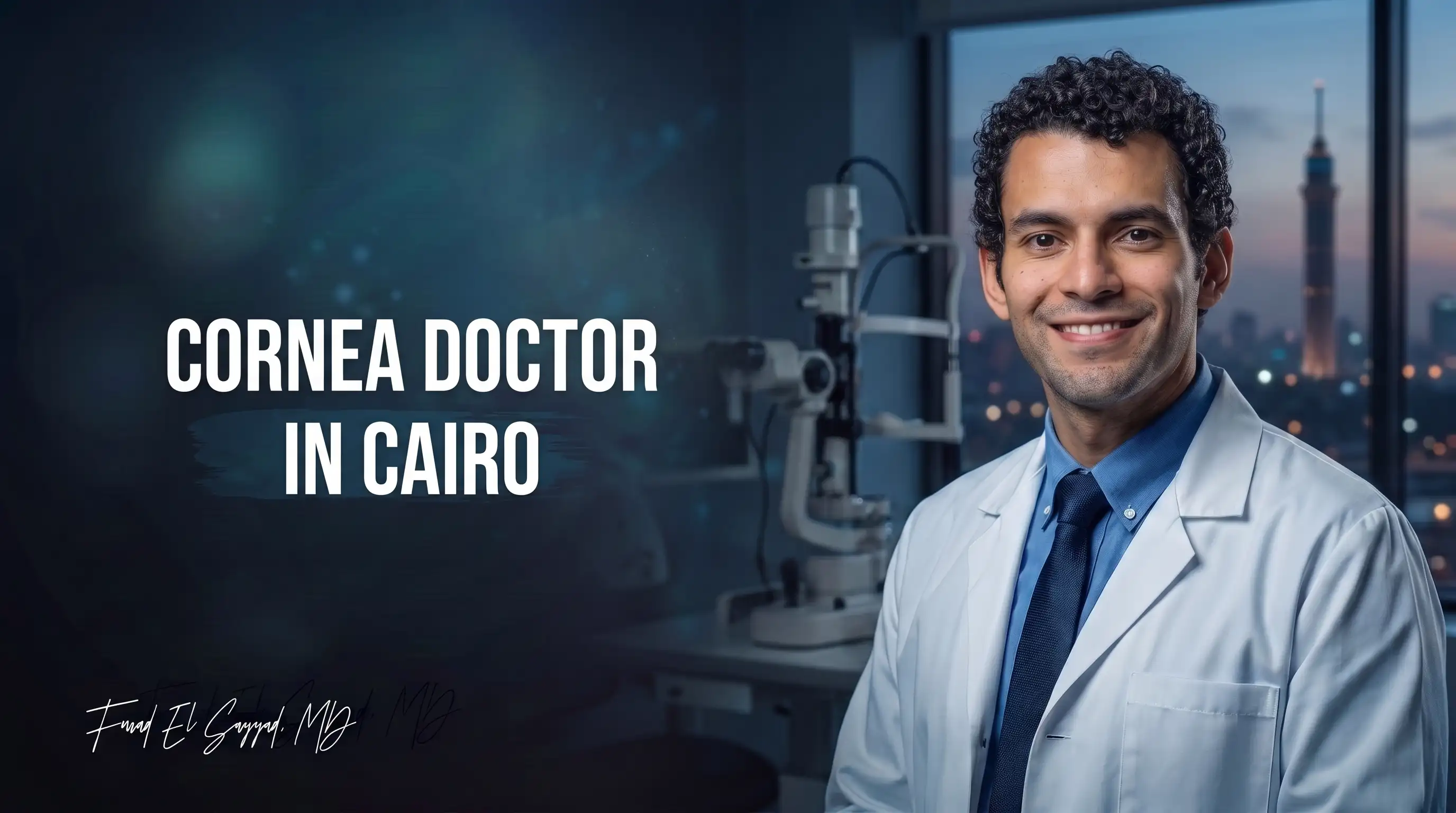
Quick answer: I am a cornea, cataract and refractive surgeon in Cairo, fellowship-trained in cornea at Washington University in St. Louis and certified by the American Board of Ophthalmology. I see patients at Sayyad Eye Center in Mohandeseen and New Cairo and treats keratoconus, corneal scars and infections, Fuchs’ dystrophy and other corneal swelling, and dry eye. Treatments include cross-linking, corneal rings, specialty contact lenses and corneal transplants (PK, DALK, DSAEK and DMEK).
Key Takeaways
- A cornea specialist diagnoses and treats diseases of the cornea, the clear front window of the eye, including keratoconus, corneal scars, infections and corneal swelling.
- Accurate diagnosis starts with corneal tomography, which maps the shape and thickness of the cornea.
- Keratoconus can often be stopped from getting worse with cross-linking, and vision can be improved with rigid or scleral lenses or corneal rings.
- When a transplant is needed, I replace only the damaged layers whenever possible (DALK, DSAEK or DMEK) rather than the whole cornea.
- To book, call or WhatsApp 01000088168.
How Do You Choose a Cornea Doctor in Cairo?
Choose a cornea doctor with specialist training in corneal disease, access to modern corneal imaging and experience with the full range of treatments, from contact lenses to every type of corneal transplant. A good cornea specialist explains every option, including when no surgery is needed, and follows you up over the long term.
- Specialist training: a fellowship in cornea and external eye disease, not general ophthalmology alone.
- Imaging: corneal tomography and anterior segment OCT to measure the cornea precisely.
- The full range of options: cross-linking, corneal rings, specialty lenses, and both full-thickness and partial (lamellar) transplants.
- Long-term follow-up: keratoconus and corneal transplants need monitoring for years.
When Should You See a Cornea Specialist?
See a cornea specialist if your vision is blurred or distorted in a way that glasses do not fix, or if a corneal problem has been suspected. Common reasons include:
- Glasses prescription, especially astigmatism, that keeps changing
- Blurred or distorted vision that new glasses do not correct
- A diagnosis or family history of keratoconus
- Cloudy vision that is worse in the morning, which can be a sign of corneal swelling such as Fuchs’ dystrophy
- A painful red eye with a white spot on the cornea, which may be an infection or ulcer and needs urgent care
- Corneal swelling or haze after cataract or other eye surgery
- Assessment before LASIK or SMILE Pro, to rule out early keratoconus
Which Corneal Conditions Do I Treat?
| Condition | Main treatments | Read more |
|---|---|---|
| Keratoconus | Monitoring, cross-linking, rigid or scleral lenses, corneal rings; DALK or PK in advanced cases | Treatment of keratoconus |
| Fuchs’ dystrophy and corneal swelling after surgery | DMEK or DSAEK (replacing the inner layer) | Corneal transplantation |
| Corneal scars and opacity | Specialty lenses, DALK or PK depending on depth | When is a transplant needed? |
| Corneal infections and ulcers | Urgent diagnosis and intensive drops; transplant only if the cornea is badly damaged | Cornea and its problems |
| Corneal weakening after LASIK (ectasia) | Cross-linking, specialty lenses | LASIK complications |
| Dry eye and ocular surface disease | Drops, eyelid treatment and punctal plugs; IPL by referral | Dry eye treatment |
How Is Keratoconus Treated?
Keratoconus treatment has two goals: stopping the cornea from getting weaker, and improving vision.
- Corneal cross-linking strengthens the cornea with riboflavin drops and ultraviolet light. Its main purpose is to stop keratoconus from getting worse; it is not mainly a treatment to improve vision. I use the Avedro cross-linking system. See vision after cross-linking.
- Rigid gas-permeable and scleral lenses give the clearest vision for most people with keratoconus, because they create a smooth surface over the irregular cornea. See rigid lenses for keratoconus.
- Corneal rings are small implants that flatten the cornea and can improve vision or lens tolerance. See corneal ring implantation.
- Corneal transplant is needed only in advanced cases with scarring or when lenses no longer work, usually as DALK, which keeps your own inner layer.
LASIK is not performed on eyes with keratoconus, because it can weaken the cornea further. Read more about how keratoconus is diagnosed.
Which Type of Corneal Transplant Might You Need?
Modern corneal transplants replace only the damaged layers whenever possible, which usually means faster recovery and a lower risk of rejection.
| Transplant | Layers replaced | Typical use |
|---|---|---|
| PK (full-thickness) | All layers | Deep scars or damage through the whole cornea |
| DALK | Front layers; your own inner layer is kept | Advanced keratoconus, front scars |
| DSAEK | Inner layer with a thin supporting layer | Corneal swelling, Fuchs’ dystrophy |
| DMEK | The thinnest inner layer only | Corneal swelling, Fuchs’ dystrophy |
Read about corneal transplant success rates and recovery after a corneal transplant.
How Is the Cornea Examined?
An accurate corneal diagnosis needs more than a vision test. My cornea assessment includes:
- Corneal tomography to map the shape and thickness of the cornea (Pentacam in New Cairo, CSO MS-39 in Mohandeseen)
- Anterior segment OCT (SOLIX) to image the corneal layers in cross-section
- Slit-lamp examination of each layer of the cornea
- Measurement of your prescription, eye pressure and tear film
- Comparison with previous scans to detect progression
My Training and Experience
I specialize in cornea, cataract and refractive surgery, with training in Egypt and the United States. I have performed more than 4,800 cataract operations.
- MBBCh, Cairo University
- Research Fellowship, Bascom Palmer Eye Institute
- Ophthalmology Residency, University of Florida
- Fellowship in Cornea, External Eye Disease, and Refractive Surgery, Washington University in St. Louis
- Diplomate, American Board of Ophthalmology (2018)
- Alpha Omega Alpha Honor Medical Society (2017)
- Member of AAO, ASCRS, ESCRS, ISRS and IKS
- More than 25 peer-reviewed publications
- Best Paper Awards: Luxor 2025; Alexandria Ophthalmology Summit 2022
Learn more about me.
How Much Do Corneal Treatments Cost?
See the price guides for corneal cross-linking, corneal rings and corneal transplant.
What Patients Say (Google Reviews)
My daughter’s experience with Dr. Fouad El Sayyad was very successful, thanks to God and then Dr. Fouad. It was a corneal cross-linking procedure, followed by the use of rigid contact lenses. … They are honest in how they deal with each case.
Google review · Sayyad Eye Center, Mohandeseen · October 2026 · translated from Arabic
I had corneal ring implantation and cross-linking with Dr. Fouad El Sayyad, and honestly he was extremely professional, with follow-up until I was completely fine. The cleanliness was of the highest standard.
Google review · Sayyad Eye Center, Mohandeseen · September 2026 · translated from Arabic
I was suffering from an eye disease that was difficult to diagnose, and I went to many doctors with no result. But Dr. Fouad El Sayyad, may God reward him, is truly a good and very skilled doctor. The follow-up, the attention to my case and the level of diagnosis and treatment were wonderful.
Google review · Sayyad Eye Center, Mohandeseen · September 2026 · translated from Arabic
Extremely professional, detail-oriented, and truly conscientious. The treatment he gave me genuinely saved my eye, and I’m incredibly grateful for that. … He follows up closely and makes you feel supported at all times.
Google review · Sayyad Eye Center, New Cairo · June 2026
Where Does Dr. Fouad El Sayyad See Patients?
- Sayyad Eye Center, Mohandeseen: 3A Gameat El Dowal El Arabeya St., Sphinx Square.
- Sayyad Eye Center, New Cairo: Medical Park 2, opposite New Cairo Court.
To book an appointment with Dr. Fouad El Sayyad, call or WhatsApp 01000088168.
Frequently Asked Questions
What does a cornea specialist do?
A cornea specialist is an ophthalmologist with extra training in diseases of the cornea. They diagnose and treat conditions such as keratoconus, corneal scars, infections, Fuchs’ dystrophy and dry eye, and perform procedures such as cross-linking, corneal rings and corneal transplants.
Can keratoconus be cured?
Keratoconus cannot be reversed, but it can usually be controlled. Cross-linking aims to stop it from getting worse, and rigid or scleral lenses, corneal rings or, in advanced cases, a corneal transplant can restore useful vision. Early diagnosis gives the best results.
Does cross-linking improve vision?
The main purpose of cross-linking is to stop keratoconus from progressing, not to improve vision. Some patients notice a small improvement over the following months, but most still need glasses or contact lenses afterwards.
Can I have LASIK if I have keratoconus?
No. LASIK removes corneal tissue and can make keratoconus worse. Other options, such as cross-linking with specialty contact lenses, corneal rings or, in selected cases, an implantable lens, may be considered after a full assessment.
When is a corneal transplant needed?
A corneal transplant is needed when the cornea is too scarred, swollen or misshapen for vision to be improved with lenses or other treatments. Common reasons include advanced keratoconus, Fuchs’ dystrophy, corneal swelling after cataract surgery and deep scars after infection.
What is the difference between DMEK and a full corneal transplant?
DMEK replaces only the thin inner layer of the cornea, so it needs few or no stitches and vision often recovers within weeks. A full-thickness transplant (PK) replaces all layers, needs stitches and takes many months for vision to settle.
Is a corneal ulcer an emergency?
Yes. A painful red eye with a white spot on the cornea, especially in contact lens wearers, can be a corneal infection. It needs examination the same day, because early treatment protects vision.
How do I book with Dr. Fouad El Sayyad?
Call or WhatsApp 01000088168 to book at Sayyad Eye Center in Mohandeseen or New Cairo. Bring any previous corneal scans, glasses and contact lens details to your visit.
This article is for general education and does not replace an eye examination. Treatment decisions depend on your own eye assessment.
References
This article is for general education and does not replace an eye examination. Treatment decisions depend on your own eye assessment.
FAQS
-
What does a cornea specialist do?
A cornea specialist is an ophthalmologist with extra training in diseases of the cornea. They diagnose and treat conditions such as keratoconus, corneal scars, infections, Fuchs’ dystrophy and dry eye, and perform procedures such as cross-linking, corneal rings and corneal transplants.
-
How much does corneal surgery cost in Egypt?
The cost depends on the procedure. See the price guides for corneal cross-linking, corneal rings and corneal transplant.
-
Can keratoconus be cured?
Keratoconus cannot be reversed, but it can usually be controlled. Cross-linking aims to stop it from getting worse, and rigid or scleral lenses, corneal rings or, in advanced cases, a corneal transplant can restore useful vision. Early diagnosis gives the best results.
-
Can I have LASIK if I have keratoconus?
No. LASIK removes corneal tissue and can make keratoconus worse. Other options, such as cross-linking with specialty contact lenses, corneal rings or, in selected cases, an implantable lens, may be considered after a full assessment.
-
Does cross-linking improve vision?
The main purpose of cross-linking is to stop keratoconus from progressing, not to improve vision. Some patients notice a small improvement over the following months, but most still need glasses or contact lenses afterwards.
-
How much does a corneal transplant cost?
The cost depends on the type of transplant your eye needs and the donor tissue. For current prices, see the corneal transplant price guide.

Book an Eye Consultation Appointment | Dr. Fouad El Sayyad
Book now